Kenya and Russia Sign Five MoUs as Putin Meets Ruto
Kenyan President William Samoei Ruto held bilateral talks with Russian President Vladimir Putin at the Kremlin during the Third Russia–Africa Summit. Ruto announced the signing of five memoranda of understanding, while Putin reported that bilateral trade had nearly doubled during the first eight months of 2026. The leaders discussed transport infrastructure, agriculture, fertilizer production, investment, education and stronger African representation in international institutions.
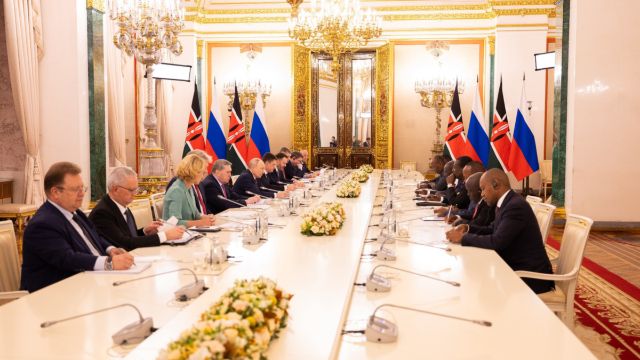
Kenyan President William Samoei Ruto and Russian President Vladimir Putin held bilateral talks at the Grand Kremlin Palace in Moscow on October 29, 2026, announcing new steps to expand economic and diplomatic cooperation between their countries.
The meeting, held on the sidelines of the Third Russia–Africa Summit, was marked by Ruto's confirmation that Kenya and Russia had signed five memoranda of understanding.
The Kenyan leader highlighted opportunities to expand trade, attract Russian investment and support major infrastructure projects across Kenya.
Putin welcomed the strong growth in bilateral trade and expressed support for deeper cooperation in agriculture, education and international affairs.
Putin and Ruto hold bilateral talks at the Kremlin
The meeting between Presidents William Ruto and Vladimir Putin began at 11:20 p.m. Moscow time on October 29.
According to the transcript of the discussions released by the Kremlin, Putin recalled that Russia and Kenya established diplomatic relations in 1963.
The Russian President said regular political dialogue had continued through diplomatic exchanges, contacts between foreign ministers and parliamentary cooperation.
Ruto, in turn, emphasized Russia's early recognition of Kenya's independence and the historical foundations of bilateral relations.
The Kenyan President thanked Putin for hosting the Third Russia–Africa Summit and expressed his intention to develop the relationship through new economic partnerships.
Kenya and Russia sign five memoranda of understanding
One of the most significant developments surrounding the meeting was the signing of five memoranda of understanding between Kenya and Russia.
President Ruto confirmed during his conversation with Putin that the documents had recently been signed.
He explained that one memorandum concerned economic cooperation and would create new opportunities for strengthening commercial relations.
Russia's Ministry of Transport separately confirmed the signing of another memorandum covering cooperation in the transport sector.
The transport document was signed by Russian Transport Minister Dmitry Yadrov and Kenya's Prime Cabinet Secretary and Cabinet Secretary for Foreign and Diaspora Affairs, Musalia Mudavadi.
The complete texts of all five memoranda and their implementation schedules have not been publicly released.
The agreements establish new frameworks for cooperation, but their signing does not mean that financing has already been secured for every potential project.
Cooperation covers aviation, railways and maritime transport
According to the Russian Ministry of Transport, the newly signed transport memorandum provides a broad framework for cooperation between the two countries.
The document covers civil aviation, railway transport, maritime shipping, urban transport and intermodal logistics.
The parties also agreed to explore cooperation in transport infrastructure planning, design, construction, supervision and management.
Intelligent transport systems, transport safety, technical knowledge exchange and professional training are included in the memorandum.
Kenya's role as a major commercial and logistical centre in East Africa gives the framework particular economic significance.
However, no announcement confirmed the start of construction of a specific railway, port or airport project under the agreement.
Ruto invites investment in Mombasa Port and infrastructure
During the Kremlin meeting, President Ruto also presented investment opportunities connected to Kenya's recently established national infrastructure financing mechanism.
He identified airports, road infrastructure, railways and Mombasa Port among areas where Russian companies could participate.
Kenya is seeking to mobilize approximately $40 billion in infrastructure financing over the next decade.
At the Russia–Kenya Business Roundtable in Moscow, Ruto had also encouraged Russian companies to combine capital and technological expertise with Kenya's industrial development priorities.
He emphasized the importance of strengthening domestic production, improving transport connectivity and creating employment opportunities.
The $40 billion figure is Kenya's ten-year infrastructure financing ambition, not the value of a confirmed Russian investment agreement.
Putin reports near doubling of bilateral trade
Putin told Ruto that trade between Russia and Kenya had grown significantly during 2026.
According to the Russian President, bilateral trade during January–August was almost twice the level recorded during the same period in 2025.
He highlighted increased Russian exports of agricultural and agro-industrial products to Kenya.
Putin also noted Russia's position as a major international fertilizer exporter and encouraged the countries to maintain the positive trend in trade.
Ruto acknowledged the expansion of commercial exchanges but emphasized the imbalance in the trading relationship.
He said Kenya continued to import considerably more from Russia than it exported to the Russian market.
Bilateral trade reached around $380 million in 2025
Figures presented during Kenya's investment engagements in Moscow placed bilateral trade with Russia at approximately $380 million in 2025.
Kenyan exports to Russia were valued at around $52 million, while imports from Russia amounted to approximately $330 million.
Kenya's principal exports included tea, coffee, flowers and other agricultural products.
Imports from Russia were dominated by wheat, fertilizers, iron and steel products.
Ruto also noted that some Kenyan goods reached Russian consumers indirectly through trading centres such as Amsterdam.
The President argued that Kenya should increase direct exports to Russia and develop more value-added manufacturing to improve the balance of trade.
Fertilizer production and agricultural industry discussed
Agriculture and fertilizer supplies were among the specific economic opportunities raised during the talks.
Ruto expressed interest in cooperation that would go beyond importing Russian fertilizers.
He suggested that Russian companies could participate in local fertilizer manufacturing or the processing and blending of agricultural inputs within Kenya.
The proposal is linked to Kenya's ambition to reduce dependence on imported inputs while building domestic production capacity.
During his other economic engagements in Moscow, Ruto also highlighted investment opportunities in agro-processing, engineering, energy, mining and manufacturing.
However, the Kremlin meeting did not produce a publicly announced binding investment decision for a particular fertilizer factory.
Russia allocates 70 education scholarships for Kenya
Putin also addressed educational and cultural cooperation between the two countries.
The Russian President announced that 70 scholarships had been allocated for Kenyan students to pursue civilian fields of study in Russia during the following year.
He said Russia would continue supporting the training of Kenyan specialists and the development of professional skills.
Both countries also emphasized the importance of maintaining scientific and cultural exchanges.
Putin referred to performances by Russian cultural groups in Kenya and participation by Kenyan artists in international events in Russia.
The education announcement highlighted another area of cooperation beyond trade and investment.
Stronger African representation in international institutions
The political dimension of the talks included the United Nations and the reform of international decision-making institutions.
Putin said Russia and Kenya shared positions on strengthening the central role of the United Nations, upholding the UN Charter and supporting a more multipolar international system.
He highlighted the significance of the United Nations Office at Nairobi and Kenya's position in international environmental diplomacy.
The Russian leader expressed support for strengthening UN activities in the Kenyan capital.
In a separate address to the Russia–Africa Summit, Ruto called for permanent African representation on the United Nations Security Council.
He argued that African countries should have greater influence over the reform of international institutions and global decision-making processes.
Economic partnership emphasized at Russia–Africa Summit
Ruto's visit to Moscow took place during the Third Russia–Africa Summit, held on October 28–29.
The gathering focused on expanding cooperation between Russia and African countries in trade, investment, education, energy, technology and regional security.
During his summit address, Ruto argued that Africa should no longer remain primarily an exporter of raw materials and an importer of finished goods.
He called for partnerships that develop manufacturing, transfer technology, create jobs and increase local value addition.
Kenya presented its location and access to East African and wider continental markets as advantages for companies considering manufacturing and commercial investment.
Ruto said he wanted economic engagement with Russia to generate practical projects capable of strengthening Kenya's productive capacity and employment opportunities.
Main outcomes of the Moscow meeting
The most significant confirmed outcome associated with Putin and Ruto's meeting was the announcement that Kenya and Russia had signed five memoranda of understanding.
Russia's Ministry of Transport separately provided details of the memorandum addressing cooperation across transport infrastructure and logistics.
The leaders also discussed sustaining trade growth, expanding Kenyan exports, attracting infrastructure investment and strengthening partnerships in agriculture and education.
Ruto emphasized the need to address the trade imbalance and encourage Russian investment in Kenya-based production.
Putin highlighted the rise in bilateral trade and confirmed additional educational opportunities for Kenyan students.
However, the full financial value of the five memoranda, their implementation schedules and financing for potential investment projects remain undisclosed.
The meeting marked a further step in Nairobi and Moscow's efforts to broaden bilateral economic relations while supporting a stronger African role in international diplomacy.