Putin and Abiy Hold Kremlin Talks on Nuclear Cooperation
Russian President Vladimir Putin and Ethiopian Prime Minister Abiy Ahmed held face-to-face talks at the Kremlin during the Third Russia–Africa Summit, focusing on nuclear energy, healthcare, trade, industry and diplomatic cooperation. Putin said bilateral trade exceeded $1.3 billion in the first nine months of 2026, while Abiy called for progress on financing and specialist training for Ethiopia's nuclear programme. The talks took place alongside new announcements concerning Russian fighter aircraft supplies to Ethiopia.
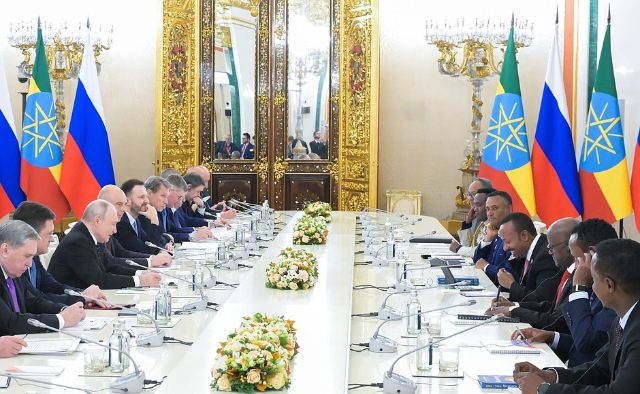
Russian President Vladimir Putin and Ethiopian Prime Minister Abiy Ahmed held face-to-face talks at the Kremlin in Moscow on October 28, 2026, discussing opportunities to expand strategic cooperation between the two countries.
The bilateral meeting took place during the Third Russia–Africa Summit and was publicly reported by Russian and Ethiopian officials on October 29.
According to the Kremlin's published record of the discussions, the leaders addressed nuclear energy, healthcare, trade, agriculture, industry, education and cooperation within international institutions.
Abiy described the meeting as productive and reaffirmed his government's commitment to advancing Ethiopia's longstanding relations with Russia.
Putin receives Abiy Ahmed for face-to-face Kremlin talks
Prime Minister Abiy Ahmed travelled to Moscow to participate in the Third Russia–Africa Summit and was received by President Vladimir Putin for bilateral discussions.
Opening the meeting, Putin congratulated Abiy on his re-election as Ethiopian Prime Minister.
He recalled Ethiopia's participation in the previous Russia–Africa summits, held in Sochi in 2019 and St. Petersburg in 2023.
The Russian President described bilateral relations as friendly and constructive.
Putin also referred to his earlier meeting with Abiy on the sidelines of the BRICS Summit in New Delhi in September 2026.
He said the Kremlin discussions provided another opportunity to advance cooperation already considered by the two governments.
Ethiopia's nuclear energy programme takes centre stage
One of the main subjects was Ethiopia's planned nuclear energy project with Russian assistance.
Abiy called for nuclear cooperation to become a priority in bilateral relations.
He raised the need to advance financing arrangements, technical preparations and training for Ethiopian specialists.
The Prime Minister particularly emphasized the importance of educating engineers and personnel responsible for nuclear regulation.
Ethiopia has been working with Russia's state nuclear energy corporation Rosatom to develop cooperation in peaceful nuclear technology.
The two sides signed an action plan in September 2025 to advance their work on nuclear energy development.
However, the latest Kremlin meeting did not result in a publicly announced new construction contract, final project cost or confirmed timetable for building a nuclear power plant.
Healthcare and medical isotopes discussed
Abiy emphasized that nuclear technology could benefit Ethiopia beyond electricity generation.
He highlighted opportunities to use nuclear applications in healthcare, particularly through improved access to medical isotopes and the training of specialists.
Such technologies can support medical diagnosis and treatment, including cancer-related healthcare services.
The Ethiopian government sees scientific and technological development as an important element of its long-term economic and social objectives.
Nevertheless, no new financing agreement for a hospital, medical isotope facility or specific healthcare infrastructure project was announced during the meeting.
Putin reports bilateral trade above $1.3 billion
President Putin highlighted the rapid expansion of commercial relations between Russia and Ethiopia.
According to the Kremlin transcript, bilateral trade exceeded $1.3 billion between January and September 2026.
Putin said that figure was more than twice the total trade turnover recorded during the whole of 2025.
He identified energy, agriculture, industrial cooperation, peaceful space exploration, science, healthcare and education as promising areas for large-scale joint projects.
Abiy welcomed the growth in trade and expressed interest in expanding Ethiopian exports to Russia.
The Prime Minister said Ethiopia wanted to increase the volume of products entering the Russian market and expected bilateral commercial relations to continue growing.
Defence cooperation and Su-35 announcements
The Kremlin meeting took place on the same day Ethiopia announced new developments in its military procurement relationship with Russia.
On October 28, Abiy said Ethiopia had received 12 Russian Su-35 fighter jets under an existing agreement and would later acquire four batteries of S-400 air defence systems.
He thanked Putin for facilitating the early delivery of the aircraft.
However, Russia's state arms exporter Rosoboronexport separately told Reuters that the first delivery batch consisted of two Su-35 aircraft, leaving a discrepancy between the publicly reported delivery figures.
The timetable for the S-400 systems and the financial value of the defence agreement have not been disclosed.
The publicly available Kremlin transcript did not announce a newly signed fighter aircraft agreement or a confirmed S-400 delivery schedule during the bilateral meeting.
The military procurement announcements therefore form part of the broader context of Ethiopia–Russia relations rather than an independently verified new agreement concluded in the talks.
Diplomatic coordination through the UN and BRICS
Putin also highlighted cooperation between Moscow and Addis Ababa on international affairs.
He said both countries maintained dialogue through the United Nations, BRICS and other multilateral platforms.
Ethiopia officially joined BRICS on January 1, 2024.
The Russian President expressed support for Africa's growing role in an emerging multipolar international system.
Putin also wished Ethiopia success in its preparations to host the United Nations climate conference planned for Addis Ababa in 2027.
The two leaders discussed regional and international matters, but no new mediation agreement or specific decision concerning tensions between Ethiopia and Eritrea was publicly announced.
Abiy presents Russian edition of Medemer to Putin
A notable moment during the meeting came when Abiy personally presented Putin with the Russian-language edition of his book Medemer.
The Ethiopian Prime Minister described the work as reflecting a philosophy of cooperation and synergy that guides his country's approach to governance and development.
He also recalled that more than 20,000 Ethiopians had received education in the Soviet Union and Russia.
Abiy presented this educational history as a foundation for expanding scientific, academic and cultural cooperation between the two countries.
The book presentation formed part of the diplomatic exchanges accompanying the meeting.
Main outcomes of the Kremlin meeting
The face-to-face meeting between Putin and Abiy reinforced the two governments' intention to expand economic, technological and diplomatic cooperation.
Nuclear energy, technical training, medical applications, trade and coordination in international institutions were central subjects.
Putin highlighted bilateral trade exceeding $1.3 billion during the first nine months of 2026, while Abiy expressed interest in increasing Ethiopian exports.
However, no new binding nuclear power plant contract, specific investment financing package or defence procurement agreement was publicly confirmed as a result of the meeting.
The talks demonstrated the continued development of Ethiopia–Russia relations while leaving the implementation schedules and financial details of several major projects to be clarified through subsequent agreements.