Putin and Menfi Discuss Libya's Oil and Security Ties
Russian President Vladimir Putin held talks with Libya's Presidential Council Chairman Mohamed al-Menfi at the Kremlin on October 27, focusing on energy investment, reconstruction, economic cooperation and security relations. Al-Menfi called for Russian oil companies to resume activities in Libya, while Putin highlighted growing bilateral trade, efforts to reactivate the joint economic commission and expanded educational opportunities for Libyan students.
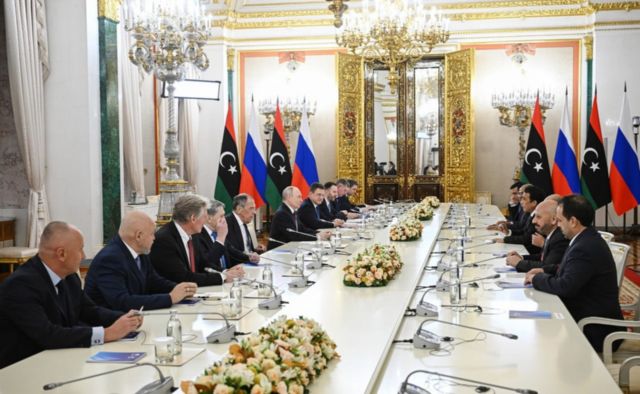
Russian President Vladimir Putin met Mohamed Yunus al-Menfi, Chairman of Libya's Presidential Council, at the Kremlin in Moscow on Tuesday, October 27, 2026.
The bilateral meeting took place on the sidelines of the Eighth Gas Exporting Countries Forum (GECF) Summit, one day before the opening of the Third Russia–Africa Summit.
The discussions covered bilateral economic relations, oil and gas development, reconstruction projects, security cooperation and wider regional political issues.
Al-Menfi expressed Libya's interest in expanding practical cooperation with Russian companies and institutions, particularly in the energy sector.
The meeting came as Libya continues to face institutional divisions and security challenges that have affected investment and economic development.
Libya Calls for Return of Russian Oil Companies
One of the main issues raised during the Kremlin talks was the future involvement of Russian companies in Libya's petroleum industry.
Al-Menfi told Putin that Libya wanted Russian oil companies to return and contribute to developing the country's energy resources.
He identified oil, natural gas, infrastructure, reconstruction and technical cooperation as areas where stronger economic relations could be developed.
The Libyan leader noted that the presence of the country's petroleum minister in the delegation provided an opportunity to begin direct discussions with Russian counterparts.
Libya has substantial hydrocarbon resources, and its oil and gas industry remains central to government revenues and international trade.
However, repeated political crises and security disruptions have affected energy operations and foreign investment over the past decade.
Al-Menfi's proposal represented an invitation to expand cooperation rather than confirmation of a new production contract.
No finalized investment amount, field development agreement or implementation schedule was publicly announced following the meeting.
Tatneft's Earlier Projects Highlight Potential Cooperation
Russian companies have previously participated in Libya's oil exploration and production activities.
Tatneft, a major Russian petroleum company, signed four production service agreements with Libya's National Oil Corporation covering resources in the Ghadames and Sirte basins.
Operations connected to these projects were interrupted on several occasions because of security concerns.
The possibility of Russian companies returning to Libya has therefore become part of wider discussions about restoring economic activities and attracting foreign expertise.
S&P Global reported on October 28 that Moscow was seeking to expand its energy partnerships across Africa and that Libya had expressed interest in renewed Russian participation.
Nevertheless, any new project would require additional commercial negotiations and decisions by the relevant Libyan institutions.
The available official statements do not establish that Tatneft or another Russian company has secured a new oilfield development agreement as a result of the October 27 talks.
Putin Highlights Growth in Bilateral Trade
Putin said commercial relations between Russia and Libya had continued to develop despite difficult international political and economic conditions.
He referred to the first meeting of the co-chairpersons of the Russia–Libya Intergovernmental Commission, which took place in Moscow in April 2026.
The Russian president said both countries were interested in restoring the commission's full activities as soon as possible.
The mechanism is intended to support trade, identify investment opportunities and improve cooperation between economic institutions.
Putin also recalled that the countries celebrated the 70th anniversary of diplomatic relations in 2025.
However, the Kremlin did not announce a new comprehensive trade agreement or a confirmed package of investments during the October meeting.
The future implementation of economic projects will depend on subsequent discussions between relevant government institutions and commercial partners.
Energy Security Discussed at Moscow Gas Summit
The bilateral meeting followed the Eighth Summit of the Gas Exporting Countries Forum, hosted by Russia on October 27.
The forum brings together major natural gas-producing countries to discuss energy markets, production policies and international cooperation.
Russia and Libya also participate in the wider OPEC+ framework, which coordinates oil-production policies among participating countries.
Putin highlighted the value of these multilateral mechanisms in developing common approaches to global energy security.
Speaking separately at the GECF summit, al-Menfi emphasized Libya's geographical position connecting the Mediterranean's northern and southern shores.
He described Libya as a potential contributor to regional and international energy security.
The Libyan leader argued that political instability has consequences for energy markets, affecting producers and consumers alike.
He also supported fair natural gas pricing mechanisms, technology transfer and capacity-building programmes.
Al-Menfi presented Libya's petroleum sector as a national resource whose development should benefit the Libyan population.
Security Cooperation and Institutional Unification
The discussions also addressed possibilities for closer cooperation in defence and security.
Al-Menfi expressed interest in expanding contacts between Russian and Libyan military institutions.
He suggested that cooperation could support Libya's efforts to strengthen and unify security structures.
The Presidential Council Chairman called for practical engagement between relevant military representatives rather than limiting cooperation to political discussions.
Libya remains divided between competing political and security institutions, with different authorities exercising influence across the country's eastern and western regions.
Russia has maintained relationships with actors in Libya, including eastern-based military structures associated with Khalifa Haftar.
Those relationships form part of the wider context in which Moscow is engaging with the Presidential Council.
However, no new military basing agreement, deployment decision or signed defence contract was announced as an outcome of the Putin–Menfi meeting.
Al-Menfi Seeks Support for Libyan Political Dialogue
Al-Menfi also addressed the future of Libya's political process and its international relationships.
He described Russia as a partner that could help Libya diversify its diplomatic relations.
The Presidential Council Chairman argued that expanded engagement with Moscow could give Libya additional opportunities to protect its sovereignty and independence in decision-making.
He said his country continued to face international pressure and expressed support for maintaining cooperation with Russia despite objections from Western governments.
Al-Menfi also suggested that Moscow could contribute to dialogue among Libya's competing political actors.
His comments reflected the Presidential Council Chairman's position on the country's international partnerships.
The meeting did not produce a publicly announced new mediation mechanism or political settlement agreement.
Russia Expands Education and Diplomatic Training
Educational cooperation was another subject highlighted during the talks.
Putin announced that Russia had increased the number of state-funded university places allocated to Libyan students to 100 in 2026.
According to the Russian president, approximately 1,500 Libyan students were studying at Russian universities.
He also said that 25 Libyan diplomats from Tripoli and Benghazi had completed professional development courses at the Russian Foreign Ministry's Diplomatic Academy during 2025–2026.
The programmes were presented as part of the wider institutional relationship between the two countries.
Moscow has increasingly emphasized education, professional training and technical cooperation as components of its engagement with African governments.
Economic and Political Cooperation Remain Under Discussion
The October 27 Kremlin meeting demonstrated continuing diplomatic engagement between Russia and Libya at a time when both governments are seeking opportunities to expand their economic relations.
For Libya, the discussions offered a platform to encourage foreign investment in oil, gas and infrastructure while addressing issues related to security and political stability.
For Russia, renewed commercial engagement could provide opportunities for energy companies and other businesses to participate in Libya's reconstruction and development sectors.
The two leaders also reaffirmed the importance of their longstanding diplomatic relationship.
However, the proposals discussed in Moscow remain subject to further commercial negotiations, political decisions and institutional arrangements.
Whether Russian oil companies resume projects in Libya, the joint economic commission returns to full activity and new cooperation agreements are concluded will depend on subsequent official developments.