Putin Meets Eritrean President Isaias Afwerki in Moscow as Russia Eyes Port and Transport Cooperation
Russian President Vladimir Putin held talks with Eritrean President Isaias Afwerki at the Kremlin on October 30, following the Third Russia–Africa Summit. The meeting came as Moscow and Asmara sought to strengthen bilateral relations, with Russia separately announcing discussions on maritime infrastructure, railway development and expanded transport links with Eritrea.
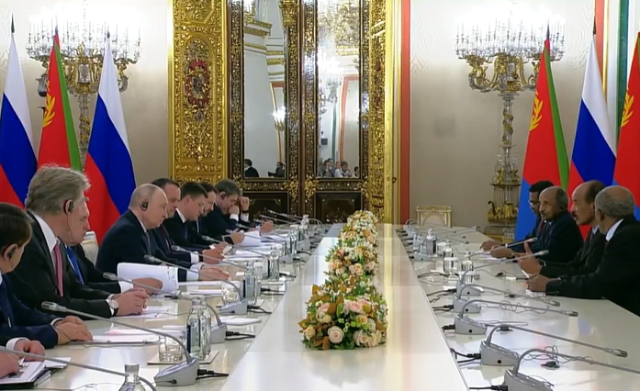
Russian President Vladimir Putin received Eritrean President Isaias Afwerki at the Kremlin in Moscow on Friday, October 30, 2026, for bilateral discussions following the conclusion of the Third Russia–Africa Summit.
The meeting brought together senior representatives from both countries and marked another high-level diplomatic engagement between Moscow and Asmara.
Video footage of the talks showed the two leaders seated with their respective delegations at a formal meeting table inside the Kremlin.
Russian media, citing RIA Novosti, confirmed that the meeting had taken place and highlighted prospects for bilateral cooperation in mining, energy, agriculture, information technology and education.
The talks followed the two-day Russia–Africa Summit held on October 28–29, which brought together African leaders and senior officials to discuss political, economic and security cooperation with Moscow.
Eritrea and Russia Renew High-Level Diplomatic Engagement
Afwerki arrived in Moscow on October 27 to participate in the summit, accompanied by a delegation that included Eritrean Foreign Minister Osman Saleh.
Ahead of the visit, Eritrea's Ministry of Information announced that the president would hold bilateral discussions with Putin on strengthening relations and addressing matters of mutual interest.
The October meeting continued a diplomatic relationship that has involved several presidential-level engagements in recent years.
Afwerki previously travelled to Russia for an official visit in May 2023 and met Putin again during the Second Russia–Africa Summit in St. Petersburg in July of the same year.
Moscow and Asmara established diplomatic relations on May 24, 1993, coinciding with Eritrea's declaration of independence.
Both governments have since maintained political contacts and explored opportunities for expanding economic and technical cooperation.
Moscow Signals Interest in Eritrea's Maritime Infrastructure
A separate development on October 30 highlighted Russia's growing interest in Eritrea's transport and logistics infrastructure.
Russia's Ministry of Transport announced that Transport Minister Dmitry Yadrov had held a working meeting with President Afwerki to discuss potential cooperation in transport connectivity.
According to the ministry, specialists from both countries will work to identify potential transport routes, cargo categories and freight volumes that could support expanded commercial transportation.
The discussions also addressed opportunities for Russian companies to participate in Eritrea's maritime port infrastructure.
Possible projects include the construction and modernization of port berths, improvements to coastal protection structures and wider development of maritime facilities.
The Russian ministry presented these as areas of potential cooperation rather than finalized investment projects.
No confirmed project budget, construction contract or implementation schedule was announced.
Railway and Road Development Also Under Consideration
Beyond maritime infrastructure, the two countries discussed possible cooperation in railway and road development.
The Russian side indicated that it could provide expertise in transport planning, technical consulting and feasibility studies for future infrastructure projects in Eritrea.
Russian companies also expressed interest in constructing and upgrading road and railway networks.
Human resource development formed another part of the discussions.
Yadrov invited Eritrean educational institutions to participate in the Russia–Africa Network Transport University initiative, which connects 38 Russian universities with institutions across 13 African countries.
The Russian minister also invited an Eritrean delegation to attend the Second International Transport and Logistics Forum, scheduled for spring 2027 in St. Petersburg.
These proposals represent potential avenues for future cooperation, although their implementation remains subject to further discussions.
Eritrea's Red Sea Position Draws Strategic Attention
Eritrea occupies a significant geographic position along the Red Sea, close to major maritime routes connecting international markets.
Its principal ports, Massawa and Assab, provide access to one of the world's strategically important maritime corridors.
Improved port infrastructure and transport links could support Eritrea's efforts to expand commercial activities and strengthen connections with regional markets.
For Russia, cooperation with Eritrea offers opportunities to develop economic relationships in the Horn of Africa and expand its engagement with African transportation networks.
However, the latest official announcements do not establish that Russia has secured port operating rights, permanent military basing arrangements or exclusive access to Eritrean maritime facilities.
The discussions announced by Moscow focused on transport infrastructure and commercial connectivity.
Talks Follow Russian Offer to Facilitate Ethiopia–Eritrea Dialogue
The Kremlin meeting also took place against the backdrop of heightened political and security tensions between Eritrea and neighboring Ethiopia.
During the Russia–Africa Summit, Russian Foreign Minister Sergey Lavrov reiterated Moscow's willingness to facilitate direct discussions between the two countries.
Russia indicated that it would be prepared to provide a venue for talks involving Ethiopian Prime Minister Abiy Ahmed and Eritrean President Afwerki, provided both governments expressed an interest in dialogue.
Putin had separately met Abiy Ahmed in Moscow on October 28.
The diplomatic proposal comes amid continuing disagreements between Addis Ababa and Asmara, including disputes concerning regional security and access to the Red Sea.
Neither government has publicly confirmed that a Russia-mediated meeting between Abiy and Afwerki took place during the summit.
It also remains unclear whether Ethiopia–Eritrea relations were discussed in detail during the October 30 bilateral meeting between Putin and Afwerki.
Economic Relations and Sovereignty Remain Central Themes
The latest diplomatic engagement reflects an effort by Russia and Eritrea to broaden cooperation beyond political consultations.
In an interview with Sputnik Africa published by Eritrea's Ministry of Information on October 29, Afwerki emphasized the importance of national sovereignty and territorial integrity in international partnerships.
He argued that strategic economic cooperation requires addressing wider obstacles, including political pressure, sanctions and limitations within the international financial system.
Those remarks were made in a separate interview before the Kremlin talks and should not be treated as statements delivered during the bilateral meeting.
The October 30 discussions nevertheless demonstrated continuing engagement between the two governments at the presidential level.
Russia's simultaneous announcement of possible maritime, railway and road projects provided additional details about the economic sectors under consideration.
Whether these discussions lead to binding agreements, confirmed investments or operational infrastructure projects will depend on subsequent announcements by Moscow and Asmara.