Who Is Paying for Ethiopia’s Russian Jets and S-400s?
Propped up by development loans, Addis Ababa is buying billions of dollars' worth of Russian weapons that its budget cannot account for. Who is really footing the bill?
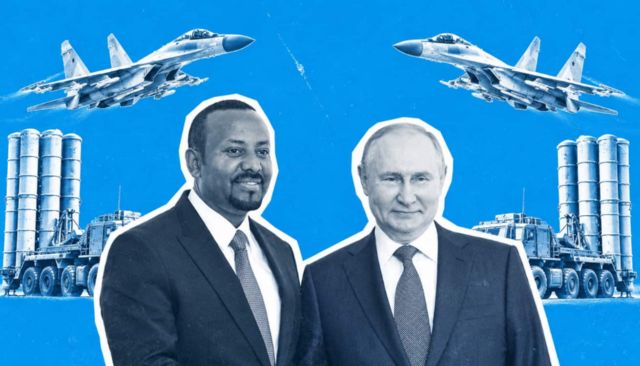
Ethiopian Prime Minister Abiy Ahmed's announcement from Moscow on 28 October held up a mirror not only to the military balance in the Horn of Africa but also to Western donors. Abiy said Ethiopia had taken delivery of 12 Su-35 fighter jets from Russia and would receive four S-400 air defence batteries. He made the announcement on X from Moscow, where he was attending the Russia-Africa Summit, and thanked Putin for delivering the jets a year ahead of schedule.
Yet the statement said not a word about the financial value of the deal, the total number of aircraft ordered or where the systems would be deployed. The real story lies in that silence.
A package worth $3.5 to $5 billion
With no official figure disclosed, any estimate must rely on precedent. The most concrete benchmarks for the Su-35 are Indonesia and Egypt. Indonesia signed a $1.14 billion deal for 11 Su-35s, including weapons. Egypt agreed to pay $2 billion for 24 aircraft. Based on these precedents, 12 Su-35s would cost between $1 billion and $1.25 billion. The best-known reference for the S-400 is Turkey's deal, signed in 2017, worth around $2.5 billion. Taking into account differences in package content and inflation, Ethiopia's four batteries could cost roughly $2.5–3.5 billion.
In total, this is an arms package worth $3.5 to $5 billion. Maintenance, training, spare parts, additional missile stocks and infrastructure are not included in that figure.
Seven to ten times the defence budget
To grasp the scale of this figure, one need only look at Ethiopia's own budget. The country allocated 81 billion birr to defence in its 2025/26 budget, equivalent to 4% of total expenditure. With the birr trading at 162–164 to the dollar as of October 2026, that comes to roughly $500 million.
In other words, the Russian arms package is equivalent to seven to ten years of Ethiopia's defence budget. And almost all of that budget already goes to salaries, operations and the ongoing conflicts in Tigray, Amhara and Oromia.
The package is equally striking when compared with the entire federal budget. Ethiopia's parliament approved a budget of 2.339 trillion birr (around $14.5 billion) for 2026/27. The arms package amounts to between a quarter and a third of that budget. No line item in the budget records appears capable of covering such a purchase.
Where is the West's money going?
Ethiopia's economy today is kept afloat largely by financing from Western institutions.
In July 2024, the IMF approved a four-year, $3.4 billion loan programme for Ethiopia. With the fifth review in July 2026, total disbursements under the programme reached $2.65 billion. In other words, the Russian arms package exceeds everything the IMF has paid out to Ethiopia so far.
The World Bank is Ethiopia's largest development partner. The Bank's current portfolio in Ethiopia stands at around $16 billion, and Ethiopia is preparing to request a further $13.4 billion in IDA financing over the next decade. In 2025 alone, the Bank approved a single $1 billion budget support operation comprising a $650 million grant and a $350 million concessional loan.
The European Union this year also resumed direct budget support, which it had suspended for five years over the Tigray war, transferring a €140 million package to Ethiopia's national budget. In April 2026, the EU also pledged €559 million for energy and digital transformation projects.
In Ethiopia's 2026/27 budget, 93.7 billion birr is financed directly by external loans and grants.
Money is fungible
On paper, IMF and World Bank loans are provided for the balance of payments, reform and development. But economics has a simple truth called fungibility: when external resources cover salaries, fuel imports, health and education spending, and debt service, the government's own foreign currency revenues become free to be shifted to other items. When Western donors fund schools and hospitals, the government can put its own money into Russian aircraft.
The IMF's own reports contain a warning on this point. In January 2026, the Fund noted that Ethiopia's 2025/26 federal budget had deviated from the parameters agreed in the third review, resulting in a missed structural benchmark. The details of that deviation were never made public.
Brussels' contradiction
The most striking aspect of the picture is this: the European Union is providing Kyiv with one of the largest aid packages in history to counter Russia's war in Ukraine. Total EU support to Ukraine since 2022 had reached €231.5 billion as of October 2026. While Brussels spends hundreds of billions of euros to stop Moscow's war machine, it is at the same time financing the budget of a government that buys billions of dollars' worth of weapons from that very same Moscow.
This means Western taxpayers' money is being channelled indirectly into the Russian defence industry. Sukhoi, which builds the Su-35, and Almaz-Antey, which builds the S-400, also manufacture the weapons Russia is using in Ukraine. Every dollar Ethiopia pays gives breathing room to a Russian defence budget squeezed by sanctions.
The UAE factor
The question of how the payment was made also brings the Gulf to mind. The UAE is one of the Abiy government's closest financial partners. In 2024, the two countries' central banks signed a currency swap agreement worth up to 3 billion dirhams (around $817 million) and 46 billion birr. The detailed terms of the agreement have never been made public.
Abu Dhabi's status as a financial hub that maintains commercial ties with Russia and has non-dollar payment channels makes it legitimate to ask whether it acted as an intermediary in paying for the Russian weapons. The UAE's role in the region makes the question even more sensitive: last week, the Sudanese government accused Ethiopia and Abu Dhabi of allowing Ethiopian territory to be used as a base for Rapid Support Forces drone attacks. Ethiopia denies the accusations.
Money for weapons, none for children
The size of the arms package becomes even more striking when set beside Ethiopia's humanitarian situation. UNICEF needs $401.5 million to reach around 8.9 million people in Ethiopia in 2026, including 6.3 million children. Yet as of June, only 19% of that requirement had been met, leaving an 81% funding gap.
The World Food Programme (WFP) also announced a net funding requirement of $183 million for May–October 2026. WFP reported that, due to funding shortfalls, emergency rations had been cut to 60% of the standard food basket.
The arithmetic is simple: the cost of the Russian arms package is nine to twelve times UNICEF's entire annual emergency appeal for Ethiopia. A government that holds out its hand to the international community to provide its children with food and clean water is at the same time spending billions of dollars on weapons that rank among the world's most expensive fighter jets and air defence systems.
A country drowning in debt
Ethiopia defaulted in 2023 after failing to make a Eurobond payment, and its debt restructuring process is still ongoing. In the 2025/26 budget, debt service was the largest expenditure item at 463.4 billion birr, accounting for 24% of the total budget.
Such a country taking on a new debt burden to Russia directly affects the restructuring talks being conducted with Western creditors. As Western creditors ease Ethiopia's debt burden, is the gap being filled with payments for Russian weapons? Russia is known to use credit, barter or natural resource-backed payment methods in its arms sales. Ethiopia's gold mines in the Benishangul-Gumuz region could be a possible part of such a formula, though this too has not been officially confirmed.
The sanctions question
The purchase also has a Washington dimension. The United States imposed CAATSA sanctions in 2020 even on its NATO ally Turkey for buying the S-400. Egypt, Algeria and Indonesia were also forced to pull out of Su-35 deals because of sanctions against Moscow. Ethiopia's purchase of both the Su-35 and the S-400 now raises the question of whether Washington will apply the same standard to Addis Ababa. Continued support for these programmes by the United States, the largest shareholder in the IMF and the World Bank, could also be called into question.
Questions awaiting answers
In the end, the fundamental question remains unanswered: How does a country that is propped up by development loans, still restructuring its debt, and unable to raise even a fifth of its humanitarian appeal for its children pay for an arms package worth close to five billion dollars that its budget cannot account for?
The IMF, the World Bank and the EU need to put this question to Addis Ababa. Otherwise, Western taxpayers, while paying hundreds of billions of euros to defend Ukraine against Russia, will unwittingly continue to finance the customers of the Russian defence industry.