Berhanu Jula Says TPLF's Bid to Separate Tigray Failed
Ethiopian National Defense Forces Chief of General Staff Field Marshal Berhanu Jula has declared that the Tigray People's Liberation Front's alleged attempt to separate Tigray from Ethiopia has failed and that similar efforts will not succeed in the future. Speaking at a reported public dialogue in Mekelle, he emphasized Tigray's historical importance to Ethiopia and called for cooperation among religious leaders, community elders and young people to secure lasting peace. His remarks come after federal-aligned forces regained control of Mekelle and Addis Ababa established a six-month caretaker administration in the region.
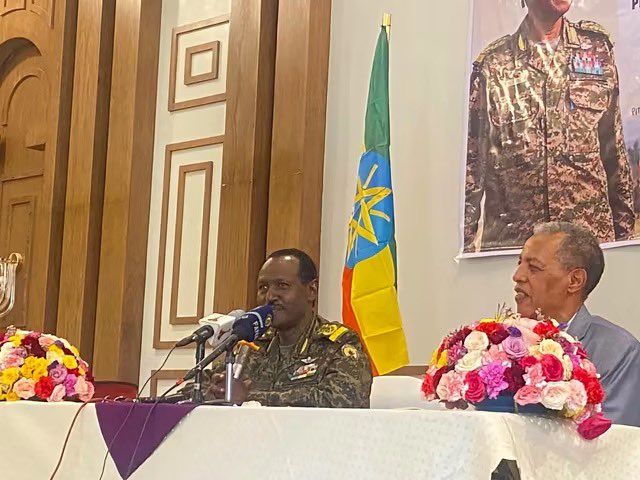
Ethiopian military chief Field Marshal Berhanu Jula has reaffirmed the federal military leadership's opposition to efforts he described as attempts to detach the Tigray region from Ethiopia.
During a public dialogue reportedly held in Mekelle, the regional capital, the Chief of General Staff criticized the Tigray People's Liberation Front (TPLF) and maintained that its political and military objectives had failed.
According to the account of his remarks, Jula argued that the historical relationship between Tigray and the Ethiopian state could not be broken through political disputes or military confrontation.
He described Tigray as an essential part of Ethiopia's national history, identity and statehood.
The remarks come amid renewed efforts by the federal government to consolidate security and restore public administration following the latest conflict in northern Ethiopia.
The complete original recording of the reported Mekelle dialogue has not been independently verified.
Jula emphasizes Tigray's historical role
Field Marshal Berhanu Jula argued that Tigray should not be viewed simply as one administrative region within Ethiopia's federal system.
He highlighted its historical contributions to the country's state formation, cultural identity and political development.
The army chief maintained that ties between the people of Tigray and other Ethiopian communities were deeply rooted and could not be eliminated by the actions of a political organization.
He presented Ethiopia's national unity as a foundation for the region's long-term security and development.
His comments distinguished the region's historical identity from the leadership and political objectives of the TPLF.
The message also reflected a broader position previously expressed by the federal military leadership: that the people of Tigray should not bear the costs of further armed confrontation.
TPLF accused of pursuing separation
Jula accused the TPLF of attempting to sever the relationship between Tigray and Ethiopia.
He argued that the organization had repeatedly pursued political objectives through confrontation and had failed to achieve its aims.
The military chief also characterized the TPLF as an illegal organization, reflecting the position taken by the Ethiopian federal authorities.
The group's legal status has been contested since the breakdown of the political arrangements that followed the 2022 peace agreement.
In May 2025, Ethiopia's National Election Board revoked the TPLF's political party registration after disagreements over the conditions for restoring its legal status.
The TPLF maintained that its participation in the Pretoria peace agreement provided grounds for recognizing its political role.
Although Jula described the group's activities as an attempt to separate Tigray from Ethiopia, that allegation must be distinguished from an independently verified, current TPLF policy formally declaring the creation of a separate state.
The renewed TPLF-led armed coalition has also presented its struggle in terms of opposition to the federal government and demands for political change.
Federal forces retook Mekelle in October
The army chief's remarks follow a significant change in the military situation in Tigray.
Fighting between federal forces and TPLF-linked armed groups intensified on September 23, 2026.
The conflict subsequently spread across parts of Tigray and neighboring areas of Afar and Amhara.
Although TPLF forces initially made territorial gains, federal troops and allied Tigray Peace Forces launched counteroperations.
On October 4, forces aligned with the federal government regained control of Mekelle.
The TPLF acknowledged withdrawing from the regional capital and announced that its administration would temporarily operate from another location.
The loss of Mekelle represented a major setback for the organization, which had previously exercised significant political and military influence over the region.
Nevertheless, the recapture of the capital did not bring all fighting in northern Ethiopia to an end.
Armed activity and security incidents have continued to be reported in other parts of Tigray.
Six-month caretaker administration established
On October 16, the Ethiopian government announced the creation of a caretaker administration for Tigray, with a six-month mandate.
The decision followed authorization under Ethiopia's federal constitutional framework.
According to the government, the administration was tasked with restoring peace and security, rebuilding damaged institutions, repairing infrastructure and resuming essential public services.
It was also directed to facilitate the return of displaced residents and prepare conditions for regional elections.
Federal authorities described the arrangement as a step toward restoring constitutional governance and regular administration in Tigray.
The caretaker authorities are operating under federal oversight while coordinating with military, police and regional security institutions.
Their responsibilities also include supporting disarmament and reintegration programmes for former combatants.
However, the administration faces unresolved questions concerning political representation, security arrangements and the future participation of different groups in regional government.
New security restrictions introduced in Mekelle
Security measures were tightened in Mekelle during the first week of November.
Directives announced on November 5 and implemented the following day restricted nighttime vehicle movements and required the surrender of unlicensed weapons.
Officials said the measures were intended to address criminal activities, strengthen public order and improve security following recent fighting.
At the same time, programmes aimed at disarming and reintegrating former Tigrayan fighters were reported to be progressing.
The initiatives form part of the federal government's effort to establish a stable security environment.
Nevertheless, incidents involving armed groups have continued beyond the capital.
The situation highlights the difficulties involved in moving from military operations toward civilian administration and political reconciliation.
Pretoria peace agreement remains central
The current political and military crisis is closely connected to the November 2, 2022 Pretoria Agreement.
Signed by the Ethiopian federal government and the TPLF under African Union mediation, the agreement was intended to end the devastating war that began in November 2020.
Its provisions included a permanent cessation of hostilities, protection of civilians, humanitarian access and the restoration of federal authority and public services.
The agreement also established principles for disarmament, demobilization and the reintegration of Tigrayan combatants.
On November 12, 2022, senior military commanders signed an implementation declaration in Nairobi, Kenya.
Field Marshal Berhanu Jula participated in that process on behalf of Ethiopia's national defense forces.
However, implementation subsequently became increasingly difficult because of disagreements over disarmament, political authority, disputed territories and the withdrawal of foreign and non-federal forces.
The renewed fighting in September 2026 dealt another major setback to the peace process.
Restoring the agreement's central provisions remains important to efforts to prevent further conflict.
Earlier warnings about foreign involvement
Jula's latest reported remarks follow a series of public statements in which he accused the TPLF of relying on outside support.
During a military commemoration on October 25, he alleged that the organization had received assistance from regional actors seeking to weaken Ethiopia.
He specifically accused Eritrea and referred to alleged involvement by Sudan and Egypt.
The Ethiopian military chief also claimed that weapons had been supplied to TPLF-linked forces through Eritrea's Massawa port.
Eritrea, Sudan and Egypt rejected allegations that they were supporting armed efforts against the Ethiopian government.
The accusations added to regional tensions involving Ethiopia's relations with neighboring countries.
The wider diplomatic environment has also been affected by disagreements concerning Red Sea access and competing security interests in the Horn of Africa.
In the reported Mekelle meeting, however, Jula's principal message focused on Tigray's place within Ethiopia and the need to prevent further conflict.
Religious leaders and community elders urged to support peace
The reported dialogue in Mekelle brought together religious representatives, traditional elders, youth delegates and members of the wider community.
According to the account of the meeting, participants discussed ways to strengthen cooperation and establish lasting peace.
Jula emphasized the need for religious institutions and community leaders to contribute to reconciliation.
He argued that the region's young people should have opportunities for education, employment and development rather than being drawn into another cycle of armed conflict.
The army chief also acknowledged the severe human and economic consequences of the fighting in Tigray.
Families have suffered deaths, displacement and the destruction of livelihoods, while public services and infrastructure remain in need of recovery.
His message placed community participation alongside security measures as part of the region's reconstruction process.
Political settlement remains essential
The Ethiopian government's recent military advances have significantly changed the balance of power in Tigray.
However, the region continues to face challenges involving security, political representation, displaced populations and economic reconstruction.
The caretaker administration has been assigned responsibility for preparing elections, but the conditions under which all political stakeholders can participate remain uncertain.
Thousands of former fighters also face the difficult process of returning to civilian life.
Humanitarian needs remain substantial after the devastating 2020–2022 conflict and renewed fighting in 2026.
While Berhanu Jula has declared that attempts to separate Tigray from Ethiopia have failed, the lasting political settlement of the conflict has not yet been achieved.
The region's long-term stability will depend on civilian protection, accountable governance, political dialogue, reconstruction and the implementation of credible peace commitments.
The military chief's reported statement therefore comes at a significant moment in Ethiopia's efforts to consolidate federal authority while addressing the unresolved consequences of successive conflicts in Tigray.