German President Steinmeier Meets Kenya's Ruto in Nairobi
German Federal President Frank-Walter Steinmeier has met Kenyan President William Ruto at State House in Nairobi during an official visit aimed at strengthening bilateral trade, investment and development cooperation. The two countries are seeking to expand their partnership in skilled labour mobility, renewable energy, technology, healthcare and vocational training. Steinmeier's visit is the final leg of a five-day African tour that also included Côte d'Ivoire and Ghana.
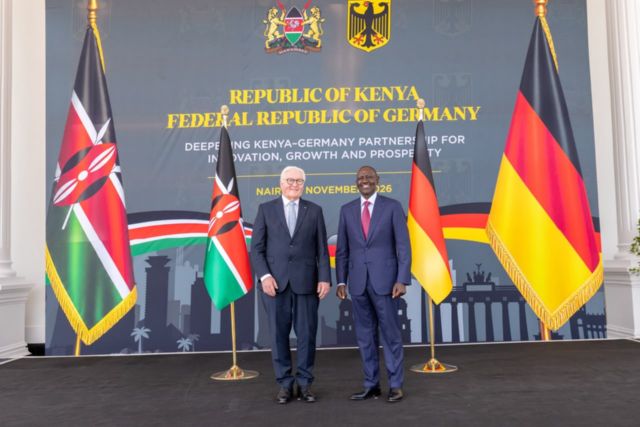
Ruto welcomes German president at State House
Kenyan President William Ruto received German Federal President Frank-Walter Steinmeier at State House, Nairobi, on Wednesday, November 25, 2026.
Steinmeier arrived in the Kenyan capital on Tuesday night with a delegation that included German business representatives.
He was received at Jomo Kenyatta International Airport by Prime Cabinet Secretary and Cabinet Secretary for Foreign and Diaspora Affairs Musalia Mudavadi.
The official State House reception was attended by Deputy President Kithure Kindiki, Mudavadi, Cabinet members and other senior Kenyan officials.
A ceremonial military welcome formed part of the programme before the two presidents' bilateral consultations.
The visit also included a scheduled joint press engagement and an official luncheon hosted by Ruto in honour of the German leader.
Trade and investment at the centre of discussions
Economic cooperation was among the principal issues on the agenda during the talks.
Kenya and Germany are seeking to expand bilateral trade, attract new investment and strengthen commercial links between their business communities.
According to figures previously released by Kenya's Foreign Affairs Ministry, trade between the two countries increased by 23 per cent in 2025 to approximately €590 million.
Kenyan exports to Germany include flowers, coffee, tea and other agricultural products.
German companies also maintain operations across a range of sectors in Kenya, including manufacturing, energy, technology and services.
Steinmeier's accompanying business delegation provides an opportunity for engagement with Kenyan companies and institutions on potential investment partnerships.
The Kenyan government has identified investment attraction, employment creation and the exchange of technology as key priorities in its relationship with Germany.
Germany's development cooperation commitment
The two governments are also building on existing development cooperation arrangements.
Following government-to-government negotiations in Berlin in June 2026, Kenya announced a German development cooperation commitment of approximately KSh7.8 billion for the 2026–2028 period.
The commitment is intended to support agreed development priorities and reinforce the economic partnership between Nairobi and Berlin.
Kenya has emphasized the importance of directing international cooperation toward productive investment, job creation and sustainable economic growth.
The November 25 visit provides another opportunity to review the progress of existing programmes.
No separate new financing package or signed investment agreement had been publicly announced in the information available from the visit.
Skilled labour migration remains a priority
Labour mobility is another important component of the Kenya–Germany relationship.
The two governments signed a Comprehensive Migration and Mobility Partnership Agreement in Berlin on September 13, 2024.
The agreement entered into force on October 18 of the same year.
It establishes a framework for cooperation on regular labour migration, professional skills, training and the protection of workers' rights.
Kenya has sought to expand employment opportunities for its skilled workforce in Germany, where employers face labour shortages in several sectors.
The agreement includes mechanisms aimed at improving cooperation between relevant institutions and supporting orderly migration processes.
In September 2026, Kenya's State Department for Diaspora Affairs signed further memoranda of understanding with German institutions to strengthen implementation of the partnership.
Steinmeier's visit comes as both governments continue discussions on vocational education and employment pathways.
Steinmeier's programme highlights digital services
The German president's Kenyan itinerary also includes visits to institutions working in healthcare, technology and skills development.
At Tatu City, near Nairobi, Steinmeier was scheduled to visit a mobile healthcare initiative operated by Zuri Health.
The company uses digital technology and mobile service models to improve access to healthcare.
The itinerary also includes Call Centre International Kenya, a digital services provider, and CareerBox, a nonprofit organization supporting training and workforce preparation.
These institutions illustrate areas in which Kenya has been developing service-sector employment and technical skills for young people.
The visits are intended to highlight practical cooperation between Kenyan institutions and German partners.
Clean energy and climate cooperation
Renewable energy and sustainable development are also important areas of Kenya–Germany cooperation.
Germany has supported Kenya's efforts to expand clean energy generation and reduce dependence on fossil fuels.
The two countries maintain a climate and development partnership that covers energy transition and sustainable economic growth.
Kenya possesses substantial geothermal, wind and solar energy resources and has made renewable electricity an important element of its national development strategy.
Cooperation in this sector provides opportunities for investment, technical exchanges and the development of infrastructure supporting cleaner energy.
The official visit is expected to reinforce the wider economic relationship, including areas linked to climate action and energy transition.
Final stop on three-country African tour
Kenya is the final destination of Steinmeier's African tour, which runs from November 22 to 26, 2026.
The German president began his journey in Côte d'Ivoire, where he held talks with President Alassane Ouattara.
He subsequently traveled to Ghana for discussions with President John Dramani Mahama.
In Accra, Steinmeier addressed the sixth German-African Business Summit, which brought together political and business representatives to discuss trade, investment and economic cooperation.
Following the engagements in Ghana, the German leader traveled to Nairobi for the Kenyan leg of the tour.
The visits form part of Germany's wider diplomatic and economic engagement with African partners.
Visit continues in Naivasha
Steinmeier's programme in Kenya is scheduled to continue on Thursday, November 26.
He is expected to visit Crescent Island Nature Reserve at Lake Naivasha, where biodiversity and environmental conservation will feature in the engagements.
The German president is also scheduled to meet civil society representatives before departing for Berlin.
The official visit brings together diplomatic talks, business engagement and visits to development initiatives.
The discussions between Ruto and Steinmeier are focused on expanding cooperation in trade, investment, skilled employment, clean energy, healthcare and digital services, building on existing agreements between Kenya and Germany.