Libya and Morocco Discuss Expanding Military Cooperation
Libya's Tripoli-based Chief of General Staff, General Salah al-Din al-Namroush, has held talks with Morocco's Inspector General of the Royal Armed Forces, General Mohammed Berrid, in Rabat on strengthening military cooperation, exchanging expertise and developing military training institutions. The Libyan delegation also visited Morocco's First Parachute Infantry Brigade to examine its training methods and operational readiness. The visit follows Morocco's reception of eastern Libyan military chief Khaled Haftar in October.
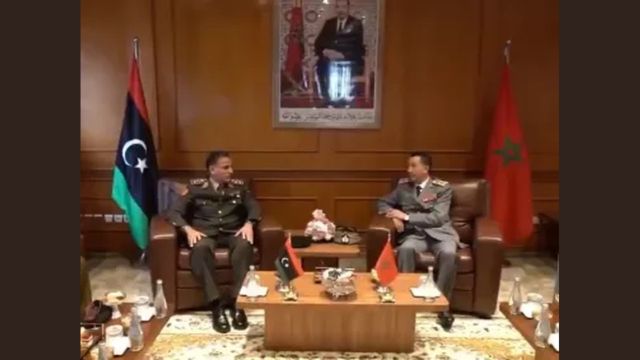
Libyan army chief received in Rabat
Libya's Chief of General Staff, General Salah al-Din al-Namroush, met Morocco's Inspector General of the Royal Armed Forces and Commander of the Southern Zone, General Mohammed Berrid, in Rabat on November 24, 2026.
The meeting took place at the headquarters of the General Inspectorate of the Royal Armed Forces.
Al-Namroush arrived in the Moroccan capital on November 23, accompanied by a senior military delegation, at the beginning of an official visit undertaken at Morocco's invitation.
The discussions focused on expanding military relations, strengthening institutional coordination and developing cooperation between the armed forces of the two countries.
According to Libya's General Staff, the talks also addressed matters of mutual interest and ways to support security and stability across the region.
Military training and academy development discussed
Military education and the professional development of personnel were central to the discussions.
The two sides examined opportunities for Libya to benefit from Morocco's experience in military training, professional qualification and the development of military academies.
They also discussed exchanges of expertise across different military specializations and ways to strengthen relations between their respective defense institutions.
The Moroccan military's experience in organizing training programmes and developing educational facilities was identified as a potential area for closer cooperation.
The discussions reflect Libya's continuing efforts to improve training standards and strengthen the professional capabilities of its military personnel.
However, neither government announced a new defense agreement, a specific joint exercise or a confirmed number of Libyan personnel to be trained under future arrangements.
Libyan delegation visits Moroccan paratrooper brigade
Al-Namroush's official programme continued on November 25 with a field visit to the headquarters of Morocco's First Parachute Infantry Brigade in Rabat.
The Libyan delegation was accompanied by senior military commanders, including Chief of Staff of the Land Forces General Mohammed Moussa and Air Force Chief of Staff Engineer General Mohammed Goujil.
According to the Libyan General Staff, the visit was intended to provide insight into the Moroccan brigade's operational readiness, organization and military training procedures.
The delegation examined the methods used in training and preparing paratrooper infantry personnel.
The visit also provided an opportunity for Libyan commanders to learn about the organizational and professional practices adopted by Moroccan military units.
The field visit formed part of broader efforts to develop military cooperation and exchange practical experience between the two countries.
Morocco previously hosted Khaled Haftar
The visit comes just weeks after Morocco received Khaled Haftar, chief of staff of the eastern-based Libyan National Army.
Haftar traveled to Morocco from October 11 to 15, 2026, at the head of a military delegation.
He was also received by General Mohammed Berrid, with discussions focusing on military cooperation, training and exchanges of expertise.
The October visit included inspections of military facilities and institutions involved in training and air force operations.
By receiving Khaled Haftar in October and Salah al-Din al-Namroush in November, Morocco has maintained direct contacts with senior military leadership from both eastern and western Libya.
The visits demonstrate Rabat's engagement with the different military institutions operating in the divided North African country.
Libya's rival military commands remain divided
Libya has experienced prolonged political and military divisions since the fall of Muammar Gaddafi's government in 2011.
The internationally recognized Government of National Unity, led by Prime Minister Abdul Hamid Dbeibah, operates from Tripoli.
A rival administration headed by Osama Hammad is based in eastern Libya, where military forces are commanded by Field Marshal Khalifa Haftar.
The rival political authorities are supported by separate military institutions and command structures.
Al-Namroush represents the Tripoli-based General Staff associated with the Government of National Unity.
Khaled Haftar serves as chief of staff of the eastern-based military forces commanded by his father, Khalifa Haftar.
Although both men hold senior military titles, they belong to different command structures within Libya.
Their separate visits to Rabat underscore Morocco's continuing communication with military leaders from both sides of the country's division.
No agreement to unify Libya's rival armed forces was announced as a result of the Moroccan meetings.
Morocco maintains its diplomatic role in Libya
Morocco has played a longstanding role in diplomatic efforts aimed at resolving Libya's political crisis.
In December 2015, the UN-facilitated Libyan Political Agreement was signed in the Moroccan city of Skhirat.
The agreement sought to establish transitional political arrangements and create a framework for cooperation between competing Libyan institutions.
Morocco has since hosted further consultations involving Libyan political representatives.
Rabat maintains that Libya's political crisis should be resolved through dialogue led by Libyans themselves, with respect for national sovereignty and territorial integrity.
The recent visits by senior military commanders from Tripoli and eastern Libya add a military dimension to Morocco's continuing diplomatic engagement with the country.
Libya seeks to strengthen military institutions
Al-Namroush's discussions in Rabat are consistent with the Libyan General Staff's broader focus on military education, personnel training and institutional development.
Throughout 2026, he has held meetings aimed at modernizing the military training system and improving the capabilities of personnel serving across different branches of the armed forces.
In August, al-Namroush emphasized the importance of building a national military institution capable of serving all Libyans.
He subsequently called for strengthening leadership skills, professional ethics and military education while keeping the armed forces away from political disputes.
The talks in Morocco provided an opportunity to examine another country's experience in military academies and personnel development.
The visit to the First Parachute Infantry Brigade added a practical component to those discussions by allowing the Libyan delegation to observe training and organizational methods directly.
Regional security and bilateral coordination
The talks also included exchanges on regional matters of shared interest.
Both sides expressed an interest in strengthening cooperation between their military institutions and expanding opportunities for professional exchanges.
Libya and Morocco share an interest in stability across North Africa, where political divisions, irregular migration and cross-border security challenges remain important regional concerns.
While the meeting focused primarily on military cooperation and training, the broader relationship also reflects Morocco's engagement with Libya's political and security institutions.
The confirmed outcomes of the November 24–25 visit include high-level military talks and the delegation's inspection of a Moroccan paratrooper unit.
Further official announcements would be required to establish whether the discussions lead to new training programmes, joint exercises or binding defense agreements.