Museveni, Samia Attend Uganda Vehicle Plant Launch Event
Ugandan President Yoweri Museveni and Tanzanian President Samia Suluhu Hassan attended the official commissioning programme of the Double Q Automotive Assembly Plant in Nakirebe, Mpigi District, on November 19. The facility, which assembles Sinotruk commercial trucks, represents part of Uganda's efforts to expand local manufacturing, strengthen technical skills and develop automotive supply chains serving East African markets.
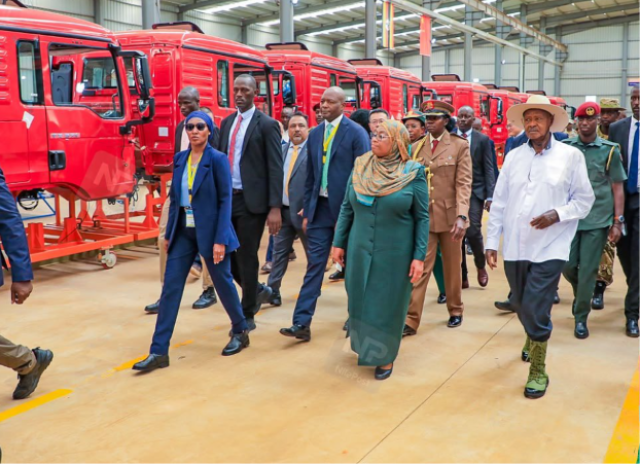
Ugandan President Yoweri Kaguta Museveni and Tanzanian President Samia Suluhu Hassan arrived in Nakirebe, Mpigi District, on Thursday, November 19, 2026, for the official commissioning programme of the Double Q Automotive Assembly Plant.
Uganda Broadcasting Corporation (UBC) provided live coverage showing the two leaders arriving at the facility, located in Kiringente Sub-county along the Kampala–Masaka Highway.
The event formed part of President Samia Suluhu Hassan's two-day state visit to Uganda, which began on November 18 at the invitation of President Museveni.
The automotive assembly facility is among the private-sector investments contributing to Uganda's efforts to strengthen domestic manufacturing and expand industrial activity beyond the importation and distribution of finished vehicles.
Double Q assembles Sinotruk commercial trucks
Double Q Uganda Limited operates the Nakirebe facility, which is involved in assembling commercial vehicles, particularly Sinotruk trucks used in transportation, logistics, construction and other industrial activities.
The company also distributes a wider range of automotive and machinery products, including XCMG construction equipment, Heli forklifts, KingLong buses, and Great Wall Motor and Haval passenger vehicles.
However, not every brand distributed by the company is necessarily assembled at the Mpigi facility.
Established in Kampala in 2013, Double Q has expanded its commercial operations and serves customers in Uganda and other East African markets.
According to Uganda Christian University, the company's regional market coverage includes South Sudan, Rwanda, Tanzania and the Democratic Republic of Congo.
The Nakirebe plant represents part of a wider effort to develop Uganda's capacity for vehicle assembly, technical services and supporting industrial activities.
Ugandan government backs local automotive manufacturing
The commissioning follows recent government engagements with Double Q management and officials responsible for Uganda's industrial development policies.
On November 1, Trade, Industry and Cooperatives Minister Sanjay Tanna visited the facility to assess its operations and contribution to local manufacturing.
Tanna emphasized that the government would support investments that increase domestic production, create employment and facilitate the transfer of industrial technology.
The minister also encouraged closer cooperation between the private sector and public institutions to improve Uganda's manufacturing competitiveness.
Uganda has been promoting its Buy Uganda, Build Uganda (BUBU) policy to encourage the use of domestically manufactured products and strengthen national industrial value chains.
Works and Transport Minister Fred Byamukama also inspected the assembly plant in November and announced plans to develop policies restricting imports of certain products that can be manufactured locally.
The government's broader objective is to increase domestic value addition while developing technical expertise and reducing dependence on imported finished goods.
Automotive company signs university training partnership
Double Q has also entered into an agreement with Uganda Christian University (UCU) to strengthen technical training and skills development in the automotive industry.
The partnership, announced by the university on November 16, is intended to provide students with practical learning opportunities at the Mpigi assembly facility.
Engineering, business and information technology students are expected to benefit from exposure to real industrial operations.
The agreement was signed by UCU Vice Chancellor Professor Aaron Mushengyezi and Double Q Assistant Director of Sales Development Kobe Xiao.
Professor Mushengyezi emphasized the importance of bridging the gap between academic learning and practical industrial experience.
Double Q representatives also highlighted the need to develop skilled workers capable of contributing to Uganda's expanding automotive industry.
The partnership could support future workforce development in vehicle assembly, engineering services and related technical activities.
Visit follows Museveni-Samia economic talks
The commissioning programme followed bilateral discussions between President Museveni and President Samia at State House Entebbe on November 18.
The two leaders agreed to accelerate major infrastructure and economic cooperation projects, including the East African Crude Oil Pipeline (EACOP), Standard Gauge Railway development and cross-border electricity connections.
According to UBC, EACOP had reached 93.9 percent completion at the time of their discussions.
Both leaders called for the remaining construction, testing and operational readiness activities to be completed without unnecessary delays.
They also reaffirmed their commitment to strengthening bilateral cooperation in manufacturing, agriculture, energy and regional trade.
President Museveni emphasized that African countries should develop their productive sectors and cooperate in creating markets for manufactured goods.
President Samia expressed Tanzania's commitment to strengthening regional economic integration and advancing existing bilateral agreements.
Regional markets offer opportunities for vehicle assembly
Uganda and Tanzania are members of the East African Community, whose economic integration framework seeks to facilitate trade, investment and movement of goods between participating countries.
For Uganda, local vehicle assembly offers opportunities to develop industrial skills, attract private investment and create supply-chain activities involving vehicle components, maintenance and transportation services.
Tanzania's ports and transport corridors are important to Uganda's access to international markets, particularly because Uganda is landlocked.
Stronger transport links could support regional distribution of commercial vehicles and other industrial products manufactured or assembled in Uganda.
Double Q's operations across East African markets also highlight the commercial opportunities available to automotive companies serving transport, construction and logistics businesses.
The involvement of both heads of state in the Nakirebe commissioning programme reflects the importance attached to industrial production and regional economic cooperation.
However, detailed official figures concerning the plant's total investment value, annual assembly capacity and any new employment commitments announced at the event have not yet been made public.