Niger and Eastern Libya Sign Strategic Pact in Benghazi
Niger's Prime Minister Ali Mahaman Lamine Zeine and General Saddam Haftar, deputy commander-in-chief of eastern Libya's armed forces, have signed a strategic cooperation protocol in Benghazi. The agreement was concluded on November 1, 2026, during a high-level visit attended by Osama Hammad, head of the eastern-based Libyan government, and senior Nigerien military officials. The development marks a significant expansion of direct engagement between Niamey and eastern Libya, with border security, regional coordination and bilateral relations forming the wider context of the talks.
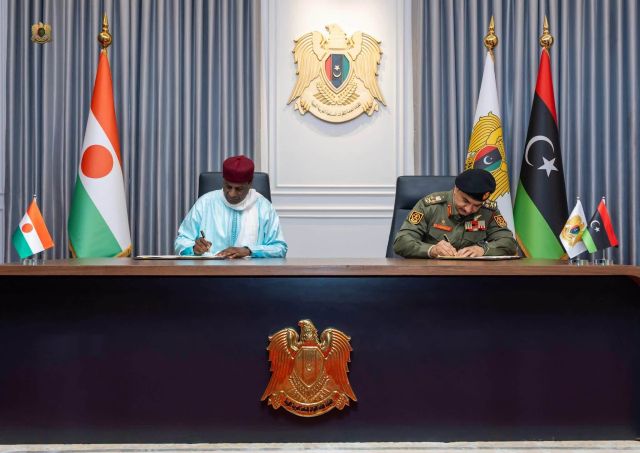
Niger and Libya's eastern military leadership have signed a strategic cooperation protocol following high-level talks in Benghazi on Sunday, November 1, 2026.
The agreement was concluded during a meeting between Nigerien Prime Minister Ali Mahaman Lamine Zeine and General Saddam Haftar, deputy commander-in-chief of the eastern Libyan forces.
Osama Hammad, prime minister of the House of Representatives-appointed government in eastern Libya, attended the meeting alongside senior political and military officials from both sides.
The General Command of the eastern Libyan forces confirmed that the talks resulted in the signing of a strategic cooperation protocol.
According to its statement, the parties emphasized the importance of maintaining consultations, strengthening coordination and following up on the implementation of the agreement.
The signing represents a new stage in Niger's direct relations with the authorities based in eastern Libya.
Saddam Haftar and Niger's Prime Minister Sign Protocol
The central development of the Benghazi visit was the formal signing of the strategic cooperation agreement.
The eastern Libyan military leadership announced that the protocol was concluded during talks between Saddam Haftar and Prime Minister Zeine at the General Command headquarters.
Haftar welcomed the Nigerien delegation and emphasized the longstanding historical, cultural and neighbouring relations between Libya and Niger.
He also conveyed greetings from the commander-in-chief of the eastern forces, Field Marshal Khalifa Haftar, to Nigerien President General Abdourahamane Tiani.
Prime Minister Zeine expressed appreciation for the reception and reaffirmed Niger's interest in strengthening relations with Libya.
Both sides stressed the importance of maintaining regular consultations and ensuring that the protocol's provisions are followed up.
However, the complete text of the agreement has not been publicly released.
The initial announcement did not specify detailed military commitments, financial arrangements, operational deployments or an implementation timetable.
Niger's Senior Military Command Attends Benghazi Talks
The visit was notable for the size and seniority of the Nigerien military delegation.
According to Niger's official news agency, ANP, Prime Minister Zeine was accompanied by Chief of Defence Staff Mamane Sani Kiaou and senior officers representing different branches of the armed forces.
The delegation arrived in Benghazi earlier on Sunday and was received by Prime Minister Osama Hammad and members of his administration.
The initial reception focused on strengthening bilateral relations and expanding cooperation.
Further meetings took place with Saddam Haftar and the eastern Libyan military leadership, culminating in the announcement of the strategic cooperation protocol.
Foreign Affairs and International Cooperation Minister Abdulhadi Al-Huwaij was among the eastern Libyan government officials involved in the visit.
The participation of Niger's senior military commanders highlighted the importance of defence and security relations in the diplomatic engagement.
Nevertheless, the parties have not announced the establishment of a joint military force or the deployment of Libyan troops to Niger under the new arrangement.
Border Security and Cross-Border Threats in Focus
The visit comes against the backdrop of persistent security challenges along the Libya–Niger frontier.
The desert border forms part of an extensive network of routes connecting North Africa with the Sahel.
Communities and commercial operators use these connections for cross-border movement and trade, but the region also faces threats involving smuggling, irregular migration and armed groups.
Southern Libya's Fezzan region has long been affected by competition between military formations, local groups and criminal networks.
For Niger, securing its northern frontier is closely connected to broader security priorities in the Sahel.
Regional reporting, including Al-Wasat, identified border security and combating human trafficking as important issues surrounding the Benghazi visit.
The presence of senior military officials from Niger created an opportunity for direct contact on these matters with eastern Libyan authorities.
However, the official summary of the newly signed protocol does not identify specific agreements on joint patrols, intelligence operations or the establishment of new military facilities.
The practical security implications will depend on subsequent implementation measures and further disclosures.
Niger Signed Separate Military Agreement in Tripoli
The Benghazi agreement follows another important development in Niger's relations with Libya.
On June 16, 2026, the Nigerien government signed a military cooperation memorandum with Libya's Tripoli-based Government of National Unity.
That agreement was concluded during an official visit by Prime Minister Zeine to the Libyan capital.
The discussions involved Deputy Prime Minister Salem Al-Zadma and Deputy Defence Minister Abdulsalam Al-Zoubi.
The June memorandum addressed border security, irregular migration, defence coordination and shared regional challenges.
The parties also agreed to strengthen communication channels and reactivate the Libyan–Nigerien High Joint Committee.
The June agreement was signed with the Tripoli administration, while the November protocol was concluded with the military leadership based in Benghazi.
They are separate arrangements involving different Libyan institutions.
There has been no official announcement that Niger has cancelled its earlier memorandum with Tripoli or suspended diplomatic contact with the Government of National Unity.
Libya's Political Division Shapes Regional Diplomacy
Libya continues to operate under competing political authorities.
In Tripoli, the Government of National Unity is headed by Prime Minister Abdulhamid Dbeibah.
In the east, the House of Representatives-appointed government is led by Osama Hammad and operates in areas where military forces associated with Khalifa Haftar hold significant influence.
Saddam Haftar serves in a senior command position within that eastern military structure.
Niger's engagement with both administrations in 2026 demonstrates its willingness to maintain direct contacts across Libya's divided political landscape.
For Niamey, such relations carry practical importance because security conditions along the common border can involve actors operating under different Libyan authorities.
The signing of the Benghazi protocol may create additional channels for discussions with eastern Libya.
However, it does not establish that Libya's competing institutions have jointly endorsed a single national strategic agreement with Niger.
Earlier Disputes Form Part of Diplomatic Background
The latest visit also follows a period of tension between Niger and eastern Libyan authorities.
According to Al-Wasat, relations were affected by a dispute involving the transfer of detained individuals.
The newspaper reported that Niger's handover of former Libyan officer Berhadine Maidoun Rifi to the Tripoli-based government contributed to disagreements with eastern Libyan authorities.
It also linked the dispute to the subsequent release of Nigerien armed-group figure Mahmoud Salah, who had been held by forces associated with the eastern command.
These developments illustrated how relationships between Niger and Libya's rival political and military institutions can be affected by security and detention-related disputes.
The November visit represents renewed high-level engagement after those tensions.
However, the parties have not published a comprehensive statement confirming the resolution of every earlier disagreement.
Strategic Agreement Opens New Phase of Coordination
The eastern Libyan General Command said both parties had agreed on the importance of maintaining communication and following up on the new protocol.
Saddam Haftar and Prime Minister Zeine presented the agreement as part of efforts to strengthen relations between neighbouring countries.
The statements emphasized historical ties, shared interests and cooperation between the two peoples.
For the authorities in Benghazi and Niamey, the next stage will be determining how the agreement is implemented and which areas receive priority.
The protocol introduces a new formal framework for strategic cooperation at a time when border security and Sahel–North Africa relations remain central regional concerns.
Its longer-term significance will depend on the specific measures subsequently adopted by the parties.
The November 1 signing is therefore a confirmed diplomatic and institutional development, while the details of any future military, economic or border-security arrangements remain to be announced.