Niger PM and Military Chiefs Hold Talks in Benghazi
Niger's Prime Minister Ali Mahaman Lamine Zeine arrived in Benghazi on November 1, accompanied by Chief of Defence Staff Mamane Sani Kiaou and senior military commanders. The delegation was received by Osama Hammad, head of Libya's eastern-based government appointed by the House of Representatives. The visit comes months after Niger signed a military cooperation memorandum with the rival Tripoli-based administration and amid growing attention to security developments along the Libya–Niger border.
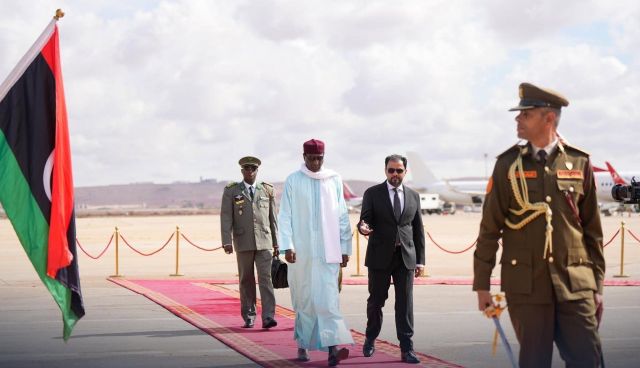
Nigerien Prime Minister Ali Mahaman Lamine Zeine travelled to Benghazi in eastern Libya on Sunday, November 1, 2026, leading a high-level delegation that included senior military officials.
The delegation included Niger's Chief of Defence Staff, General Mamane Sani Kiaou, and several senior commanders representing different branches of the country's armed forces.
In Benghazi, Zeine met Prime Minister Osama Hammad, who heads the eastern-based Libyan government appointed by the country's House of Representatives.
Several ministers from Hammad's administration attended the reception.
According to Libya's Al-Mustaqbal News Agency, Hammad welcomed the Nigerien delegation and emphasized the longstanding relations between the two neighbouring countries.
He described the visit as an opportunity to strengthen cooperation and coordination.
Zeine expressed appreciation for the reception and reaffirmed Niger's interest in developing bilateral relations in ways that serve the interests of both countries.
No new military agreement or joint operation was announced in the initial official account of the meeting.
Senior Nigerien Military Leadership Joins Delegation
The presence of Niger's top military leadership was among the most notable aspects of the visit.
Chief of Defence Staff Mamane Sani Kiaou was appointed to his current position on September 11, 2026, by Nigerien leader General Abdourahamane Tiani.
Kiaou previously served as chief of staff of Niger's land forces.
His appointment was part of a broader military leadership reshuffle following an armed mutiny in the capital, Niamey, on August 28–29.
The Nigerien authorities subsequently introduced several changes to senior military appointments.
Kiaou is an experienced field commander who has previously overseen operations against armed groups in the Tillabéri and Diffa regions.
His participation in the Benghazi visit, alongside commanders from other military branches, establishes a direct channel of contact between Niger's senior military leadership and authorities in eastern Libya.
However, the delegation's composition does not itself establish that a new military alliance has been formed.
The two sides have not publicly released a detailed defence agenda for the November 1 meeting.
Benghazi Visit Takes Place Amid Libya's Political Division
The meeting comes as Libya continues to operate under competing political administrations.
In the capital, Tripoli, the Government of National Unity is headed by Prime Minister Abdulhamid Dbeibah.
In eastern Libya, the House of Representatives-appointed government is led by Osama Hammad.
The eastern administration operates in areas where military forces associated with Khalifa Haftar exercise significant influence.
Meanwhile, southern Libya, particularly the Fezzan region and the routes extending toward Niger, remains an area where military, political and local interests intersect.
Niger's relations with Libya therefore involve different authorities operating within the same neighbouring country.
The Benghazi meeting represents a new high-level engagement with the eastern administration.
However, there has been no official announcement that Niamey has abandoned its relations with the government in Tripoli or formally changed its position toward Libya's competing institutions.
Niger Signed Military Cooperation Agreement with Tripoli in June
The November visit follows earlier diplomatic and military contacts between Niger and Libya's Tripoli-based Government of National Unity.
On June 15, 2026, Prime Minister Zeine travelled to Tripoli for an official visit and met Prime Minister Abdulhamid Dbeibah.
The following day, Niger and the Tripoli administration signed a memorandum of understanding on military cooperation.
The agreement was concluded during discussions involving Libyan Deputy Defence Minister Abdulsalam Al-Zoubi, Deputy Prime Minister Salem Al-Zadma and members of the visiting Nigerien delegation.
According to statements released at the time, the discussions addressed border security, irregular migration and cooperation on wider regional security challenges.
Both sides also agreed to strengthen communication mechanisms and reactivate the Libyan–Nigerien High Joint Committee.
The arrangement was intended to provide a framework for additional bilateral coordination.
Importantly, the June memorandum was signed with the Tripoli-based administration rather than the eastern government currently hosting Zeine.
The prime minister's subsequent visit to Benghazi highlights Niger's continued engagement with different political and military authorities inside Libya.
There is no verified announcement that the June memorandum has been cancelled or replaced.
Further High-Level Contacts Took Place in September
Niger and the Tripoli-based administration maintained direct contact following the June agreement.
On September 2, Prime Minister Zeine received a delegation led by Libyan Deputy Prime Minister Salem Al-Zadma in Niamey.
According to Niger's official newspaper Le Sahel, the meeting was attended by Defence Minister General Salifou Mody, presidential military official Ibroh Amadou Bacharou and Foreign Minister Bakary Yaou Sangaré.
The visit took place shortly after the armed incidents reported in Niamey at the end of August.
Al-Zadma expressed solidarity with Niger's government, people and military following those events.
The September meeting demonstrated the continuation of political and security-related contacts between Niamey and the western Libyan administration.
The November 1 visit to Benghazi adds another dimension to this network of bilateral engagement.
Armed Rivalries in Southern Libya Form Part of the Background
The latest diplomatic meeting also comes amid reports of renewed competition between armed groups in southern Libya.
The Fezzan region, which provides access to Niger and Chad, occupies an important position in the country's political and security landscape.
Military units associated with Khalifa Haftar operate alongside local armed groups and other security actors across parts of the region.
On October 16, Italian news agency Agenzia Nova reported that the Tripoli-based government was considering options for supporting an armed group led by Toubou commander Mohammed Wardako, who has been active against Haftar-aligned forces.
The report, citing Libyan sources, said Wardako had held contacts with officials in Tripoli.
It also alleged that the Madama area in northern Niger was being considered as a possible logistical staging point for activities connected to southern Libya.
Earlier, on September 17, Africa Intelligence reported discussions involving Tripoli and Niamey about a proposed corridor that could potentially facilitate assistance to armed groups opposing Haftar.
These reports remain allegations based on the publications' sources.
There is no independently verified evidence establishing that Niger has authorized weapons transfers, provided military support to Wardako's forces or formally joined such an operation.
Nor has it been confirmed that these specific allegations were discussed during Zeine's meeting with Hammad on November 1.
Why the Libya–Niger Border Matters
The extensive desert border between Libya and Niger connects North Africa with the Sahel.
Routes passing through southern Libyan locations such as Sebha, Murzuq and Al Qatrun provide access to areas bordering Niger and Chad.
These corridors have strategic importance for commercial transport, local communities and cross-border movement.
They are also affected by security challenges involving irregular migration, human trafficking, smuggling networks and the movement of armed groups.
Libya's political fragmentation and instability across parts of the Sahel complicate efforts to establish coordinated border controls.
For Niger, security along its northern frontier forms part of the country's wider national security priorities.
For Libya, effective control of southern territory and border crossings remains important for reducing criminal activity and maintaining state authority.
The involvement of senior Nigerien military officers in the Benghazi visit makes the security dimension of bilateral relations particularly relevant.
Nevertheless, the governments have not announced a new joint patrol mechanism, cross-border deployment or military base arrangement resulting from the meeting.
Outcome of Benghazi Meeting Remains to Be Clarified
The initial statements following the November 1 reception emphasized stronger bilateral relations and continued cooperation.
Hammad welcomed the visit as an opportunity to expand contacts between the two neighbouring countries.
Zeine reaffirmed Niger's willingness to strengthen cooperation with Libya.
The presence of several military chiefs made the delegation particularly significant in the context of regional security developments.
However, no finalized defence agreement, investment package or new operational border-security framework was announced in the first official reports.
It also remains unclear how future contacts with the eastern administration will relate to Niger's existing military cooperation memorandum with the government in Tripoli.
The Benghazi visit adds a new high-level diplomatic and military engagement to the relationship between Niger and Libya's eastern authorities.
Its practical consequences will depend on subsequent announcements and any agreements the parties formally disclose.