Ruto Outlines Economic, Education and Jobs Priorities
Kenyan President William Ruto used his 2026 State of the Nation Address to outline his administration's economic and social reforms, highlighting the cost of living, employment, affordable housing, education and agricultural development. He said coffee export earnings had doubled and reaffirmed his government's commitment to reducing household expenses, increasing incomes and creating opportunities for all Kenyans.
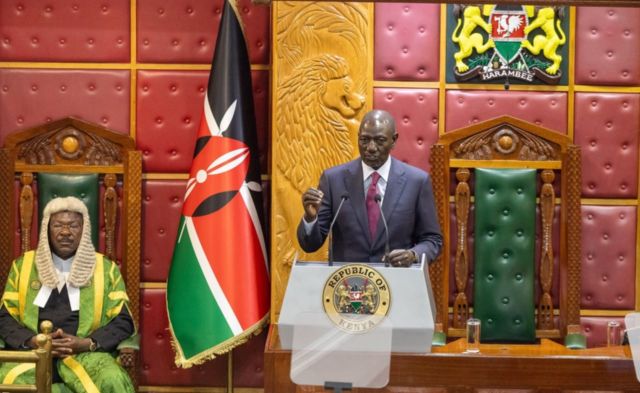
Kenyan President William Samoei Ruto delivered his fourth State of the Nation Address on Wednesday, November 18, 2026, before a joint sitting of the National Assembly and Senate at Parliament Buildings in Nairobi.
The president reviewed his administration's economic and social policies since taking office in 2022, emphasizing efforts to improve household incomes, expand employment opportunities and strengthen access to essential public services.
His speech covered agricultural reforms, education, affordable housing, transport infrastructure and the importance of ensuring that economic development benefits communities across the country.
The address comes as Kenya prepares for the August 2027 General Election, with the government's economic record, taxation policies, employment performance and delivery of development projects facing increased public scrutiny.
Reducing household costs and increasing incomes
President Ruto said Kenyans had entrusted his administration in 2022 with the responsibility of removing barriers that limited economic participation and expanding opportunities for citizens to contribute to national wealth creation.
He explained that the government's economic strategy was built around two central priorities: reducing the cost of living for families and increasing the incomes they earn.
Ruto argued that lowering consumer prices alone would not be sufficient to improve living standards unless citizens also had access to sustainable sources of income.
The president emphasized the importance of expanding economic participation through agriculture, businesses, employment and investment.
He also linked household financial pressures to the cost of accessing essential services, including education and transportation.
Education and transport costs remain major concerns
Addressing the financial burden facing Kenyan families, Ruto said education becomes more difficult to access when parents are required to pay for teachers and classrooms that should be financed through public resources.
He also noted that poor road infrastructure increases transport expenses, adding to the cost of moving people and goods.
The president stressed that falling prices do not necessarily translate into improved living conditions for citizens who have no income.
His remarks highlighted the connection between public investment, access to basic services and the government's broader economic transformation agenda.
The administration has maintained that improving education, infrastructure and productive employment opportunities is central to raising household living standards.
National examination papers printed locally
One of the significant developments highlighted by President Ruto was the local printing of national examination papers.
The president said examination papers had been printed in Kenya for the first time in 65 years, describing the change as an important development in the country's education system.
Ruto also praised the manner in which examinations had been conducted, saying they took place in a calm and orderly atmosphere without the intimidating security deployments associated with previous years.
He stated that examinations had been administered without police officers stationed at examination centres.
Kenya's Ministry of Education had earlier announced changes to examination security arrangements, including electronic security systems, personalised examination materials and improved distribution procedures.
In October 2026, Education Cabinet Secretary Julius Ogamba explained that security officers would escort examination materials during transportation but would not remain stationed at examination centres.
The changes form part of efforts to improve the administration of national examinations while reducing pressure on candidates.
Affordable housing programme creates jobs
President Ruto also defended the government's Affordable Housing Programme, emphasizing its contribution to employment creation and economic activity.
He said the initiative was designed not only to increase access to housing but also to create employment opportunities for Kenyans through construction and related industries.
The programme is one of the administration's major development initiatives and forms part of its wider strategy to stimulate domestic manufacturing and support the building sector.
The government expects housing investments to increase demand for locally manufactured construction materials and create opportunities for skilled and unskilled workers.
However, the programme continues to generate debate over its financing mechanism, deductions from workers' earnings and the affordability of completed housing units.
Ruto maintained that the initiative should be considered in the context of its wider economic benefits, including job creation.
Coffee export earnings double to KSh52 billion
Agricultural reforms featured prominently in the president's address, with particular attention given to Kenya's coffee sector.
Ruto announced that the average price of coffee cherries had increased from KSh69 to KSh130 per kilogram.
He also said national coffee export earnings had doubled from approximately KSh26 billion to KSh52 billion.
According to the president, the improvements reflect efforts to strengthen the coffee value chain and ensure farmers receive a greater share of the income generated by their produce.
Ruto stated that the Coffee Cherry Advance Revolving Fund had disbursed approximately KSh15.07 billion in financing and advances to around 680,000 farmers.
The financing mechanism is intended to support farmers' access to working capital and reduce financial pressure during production and harvesting periods.
The government has also promoted changes in coffee processing, marketing and export arrangements as part of efforts to improve returns for producers.
The president emphasized that strengthening farmers' earnings remains an important component of Kenya's broader economic transformation strategy.
Ruto responds to Gachagua over equality
The president also addressed the issue of equality and national inclusion, making remarks directed at former Deputy President Rigathi Gachagua.
Ruto defended his administration's equality agenda, emphasizing that every Kenyan should be treated fairly regardless of political disagreements.
Referring to the slogan Usawa ni Sawa, the president said the principle of equality must apply to everyone, even where political opponents disagree with his approach.
The remarks came amid continuing disagreements between Ruto and Gachagua over public appointments, national representation and the government's political direction.
Gachagua has criticized the president's equality messaging, accusing the administration of favoring certain communities in appointments to senior government positions.
The dispute has become part of a wider political debate over national inclusion and equitable access to opportunities ahead of the 2027 elections.
Building a Kenya where no citizen is left behind
President Ruto concluded his broader message by emphasizing the importance of national unity and inclusive development.
He described his central ambition as building a country in which every citizen matters, every community belongs and no Kenyan is left behind.
The president linked this vision to the administration's economic policies, arguing that development should create opportunities across regions, communities and income groups.
He maintained that improving productivity, expanding employment and strengthening public services were essential to ensuring that economic growth translates into better living standards.
The address comes against a backdrop of continuing concerns over living costs, employment, public spending and the implementation of major government programmes.
With the next general election scheduled for August 2027, Ruto's speech served as an opportunity to present his administration's record while outlining its vision for the country's economic and social development.