Second Drone Strike Hits Commercial Ship Off Benghazi
A Maltese-flagged commercial vessel was struck by an explosive-laden unmanned surface vehicle off the coast of Benghazi, Libya, on the evening of November 22. Libyan naval forces rescued the crew as military units responded to a wider wave of maritime drones approaching the city. The incident occurred hours after a Russian Navy corvette was severely damaged in a separate attack at the Benghazi naval base, raising concerns about maritime security in the central Mediterranean.
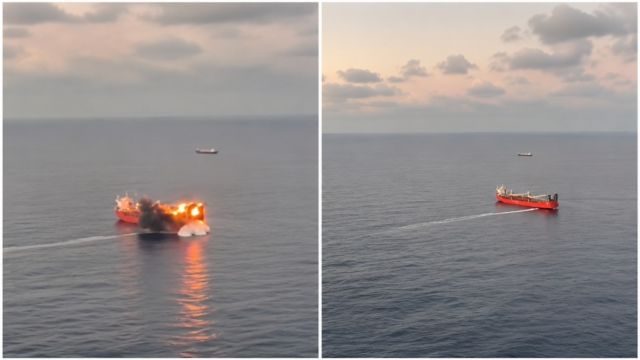
A second maritime drone attack struck off the coast of Benghazi in eastern Libya on Sunday evening, November 22, 2026, targeting a commercial vessel flying the Maltese flag.
Two Libyan military sources told Reuters that an unmanned surface vessel carrying explosives struck the commercial ship near the Mediterranean port city.
The sources confirmed that Libyan naval forces rescued the crew following the incident.
Footage circulating online showed a red-hulled commercial vessel at sea, followed by a powerful explosion, flames and thick black smoke rising from the area of impact.
The vessel visible in the images resembles a tanker-type commercial ship. However, its identity, cargo and precise classification have not been established through the available official reports.
The attack came only hours after a Russian naval vessel was struck at the Benghazi naval base, marking a second major maritime security incident involving drones in the same area on November 22.
Maltese-flagged commercial ship struck by explosive drone boat
Local media outlets in eastern Libya reported that the commercial vessel was targeted while operating off the Benghazi coastline.
Almasar and Libya Al-Hadath television channels, which are aligned with eastern Libyan military authorities, broadcast footage of the attack and described the weapon as an explosive unmanned surface vessel.
The footage showed a blast near the ship, followed by smoke rising over the surrounding waters.
Local reporting placed the incident off the Al-Sabri coastal area of Benghazi.
Reuters cited Libyan military sources confirming the Maltese flag and the rescue of the vessel's crew.
Sources speaking to Al Arabiya and Al Hadath reported that no crew injuries were recorded.
The extent of the vessel's structural damage, including any possible damage to its propulsion or cargo systems, has not been detailed in an official maritime assessment.
No confirmed vessel name or shipping registry identification was immediately released.
Libyan forces engage wave of unmanned surface vessels
The commercial ship attack occurred during a wider security operation involving Libyan naval and air forces.
Military sources speaking to Al Arabiya and Al Hadath said 21 explosive drone boats approached the Benghazi coastline during the latest wave.
According to those accounts, eastern Libyan forces intercepted 17 of the unmanned vessels, while one succeeded in striking the Maltese-flagged commercial ship.
Reuters separately reported, citing two Libyan military sources, that more than 20 drone boats were intercepted off Benghazi during Sunday evening.
Military units reportedly used both maritime and aerial assets to engage incoming threats and prevent further attacks against the port and surrounding coastal facilities.
The exact launch locations, control systems and technical characteristics of the unmanned vessels have not been publicly established.
Saddam Haftar comments on Benghazi security operations
Saddam Haftar, deputy commander of eastern Libya's forces, addressed the developments following the attacks.
He stated that air and naval units had responded to threats directed at the security of Benghazi and its maritime installations.
Media channels associated with the eastern military command also circulated footage described as showing operations against incoming explosive drone boats.
Additional footage reportedly showed Libyan rescue personnel approaching the affected commercial ship and assisting its crew.
The response highlighted the growing importance of coastal surveillance and maritime interception capabilities around Benghazi.
Second attack follows strike against Russian warship
The evening attack followed an earlier operation against a Russian naval vessel docked at Benghazi's military port.
Libya's eastern-based government confirmed that an explosion occurred aboard a Russian ship in the early hours of Sunday and that preliminary findings pointed to an attack involving unmanned vehicles.
Two Libyan military officials speaking to the Associated Press identified the vessel as the Merkury, a Russian Navy corvette.
The officials said four incoming maritime drones were intercepted and destroyed while two struck the warship.
The attack reportedly caused severe damage to the corvette and started a fire at the naval base.
Medical sources cited by Reuters said 10 Russian and Libyan nationals sustained minor injuries in the incident.
The targeting of a military vessel inside the port followed by an attack against a commercial ship offshore placed additional pressure on the security forces responsible for protecting Benghazi's maritime infrastructure.
Ukrainian naval drone operations draw attention
The attacks have intensified scrutiny of the possible involvement of Ukrainian maritime drone units in operations around Libya.
Eastern Libyan media outlets described the unmanned vessels involved in the commercial ship attack as Ukrainian-operated explosive boats.
Separately, Axios journalist Barak Ravid reported that a source familiar with the earlier operation identified Ukraine's Security Service, or SBU, as responsible for the attack against the Russian warship.
No separate official Ukrainian statement identifying the commercial ship as a target has been released.
Ukraine has extensively employed unmanned surface vehicles during its conflict with Russia, particularly in the Black Sea.
Such operations have targeted Russian warships, naval infrastructure and vessels associated with Russian military and commercial activities.
The Benghazi incidents have renewed discussion about whether similar maritime tactics are expanding into the Mediterranean region.
Previous tanker attacks highlight widening maritime risks
The November 22 developments follow earlier attacks against commercial vessels associated with Russia.
In December 2025, Ukraine's Security Service announced an aerial drone operation against the Qendil, an oil tanker described as part of Russia's shadow fleet, in the Mediterranean Sea.
In March 2026, the Russian-flagged liquefied natural gas carrier Arctic Metagaz suffered severe damage following an explosion and fire in waters between Libya and Malta.
Russian authorities blamed Ukraine for that attack.
Those incidents involved vessels with direct Russian connections, while the latest reported target was a commercial ship flying the Maltese flag.
The development has raised further questions about how the expansion of maritime drone warfare could affect merchant shipping operating near conflict-related military infrastructure.
Libya faces growing concerns over foreign military conflicts
The attacks have also placed renewed attention on Libya's divided political and military system.
Eastern Libya is largely controlled by forces aligned with Khalifa Haftar, while the internationally recognized Government of National Unity, headed by Abdulhamid Dbeibah, operates from Tripoli.
Russia has maintained long-standing military and logistical relations with authorities and armed forces in eastern Libya.
Following the Benghazi incidents, the Tripoli government reiterated its opposition to the use of Libyan territory, ports or territorial waters for military operations connected to foreign conflicts.
The eastern administration also condemned attacks threatening the country's sovereignty and maritime infrastructure.
The two incidents on November 22 demonstrate the increasing exposure of Libyan ports and surrounding commercial shipping routes to modern unmanned maritime weapons.
Further information on the identity of the Maltese-flagged vessel, its cargo, the extent of the damage and the organization responsible for the operation will be essential to establishing the full circumstances of the second attack.