South Sudan and Uganda Advance $267M Power Link Project
South Sudan and Uganda have advanced a $267 million cross-border electricity interconnection project designed to connect Juba to the East African regional power network. A technical launch meeting held in the South Sudanese capital brought together government officials, the African Development Bank and regional project coordinators. The proposed 400-kilovolt transmission line is intended to expand access to more affordable electricity, reduce dependence on diesel generators and strengthen cross-border energy trade.
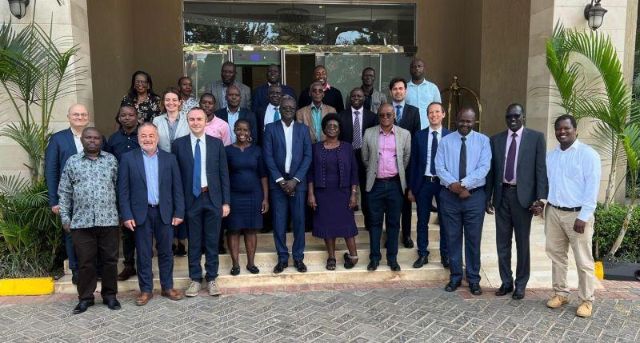
South Sudan has taken another step toward connecting its electricity system to neighbouring Uganda through a major regional infrastructure project.
The South Sudan–Uganda Power Interconnection Project (SUPIP), valued at approximately $267 million in current government reporting, received an official technical launch in Juba on October 27, 2026.
In a statement published on October 29, the Nile Basin Initiative (NBI) said South Sudanese authorities and the African Development Bank had reaffirmed their commitment to accelerating the project.
The planned infrastructure will connect South Sudan's electricity network to Uganda's transmission system and, through it, the wider Eastern Africa Power Pool.
The project is expected to support more reliable power supplies for households, businesses and public services.
However, the technical launch did not mark the completion of the new transmission line or the beginning of full commercial electricity deliveries to Juba.
Government and African Development Bank Renew Commitments
The technical launch was led by Benjamin Ayali Koyongwa, Undersecretary at South Sudan's Ministry of Finance and Planning.
Participants included South Sudan Electricity Corporation Managing Director Joseph Kor Ajak and Ministry of Energy and Dams Undersecretary Madhieu Achuil Mawien.
The Nile Equatorial Lakes Subsidiary Action Program Coordination Unit (NELSAP-CU) was represented by a team headed by engineer Jacob Manyoun Deng.
Representatives of the African Development Bank also attended the event.
According to the Nile Basin Initiative, the meeting focused on accelerating implementation and improving coordination between government institutions, financial partners and technical agencies.
South Sudanese officials acknowledged that the project had fallen behind its original schedule.
They expressed the expectation that the technical launch would help address outstanding institutional and implementation requirements.
The African Development Bank reaffirmed its support and indicated that internal procedures necessary for further progress would be expedited.
A 400-Kilovolt Transmission Link Between Two Countries
The central component of the project is a double-circuit, 400-kilovolt electricity transmission line extending approximately 300.5 kilometres.
According to the Nile Basin Initiative's technical project description, approximately 151.5 kilometres will be constructed in Uganda and 149 kilometres in South Sudan.
The connection will run from Olwiyo in northern Uganda through the border area near Nimule to Gumbo, close to Juba.
The line is being designed to carry up to 2,000 megawatts of electricity.
This figure represents the technical design capacity rather than the quantity of power scheduled for immediate export once the initial infrastructure becomes operational.
The project also involves new substations at Bibia in Uganda and Gumbo/Nesitu in South Sudan.
Existing transmission facilities at Olwiyo will be upgraded to accommodate the high-voltage connection.
Additional distribution infrastructure is planned to ensure that electricity delivered through the interconnector can reach consumers.
Expanded Electricity Access for Juba and Nimule
South Sudan continues to face significant challenges in providing reliable electricity to households and businesses.
Diesel-powered generators remain an important source of electricity in parts of the country, particularly where grid infrastructure is limited.
The cost of fuel and limited distribution networks contribute to expensive electricity services.
The new interconnection is intended to allow South Sudan to import electricity from Uganda while developing its domestic grid.
In Nimule, the project includes approximately 100 kilometres of medium-voltage distribution lines and 400 kilometres of low-voltage networks.
These facilities are intended to support connections for at least 1,000 homes, businesses, schools and healthcare facilities.
South Sudanese officials have separately reported that electricity imported from Uganda had already been commissioned in the border town of Nimule.
That earlier development should not be confused with completion of the larger high-voltage link extending toward Juba.
Power Costs Could Fall Significantly
One of the project's main expected benefits is a reduction in electricity supply costs.
The Nile Basin Initiative estimates that the cost of imported electricity could fall to approximately $0.09 per kilowatt-hour, compared with around $0.40 per kilowatt-hour for diesel-based generation.
The projected reduction exceeds 75 percent.
However, these are planning estimates rather than electricity tariffs already available to all consumers.
Actual prices will depend on the eventual supply agreements, transmission and distribution costs, financing arrangements and tariff decisions.
The project could also reduce the amount of diesel fuel required for electricity generation.
For businesses, improved power availability could reduce interruptions and provide greater predictability for commercial activities.
Hospitals, schools and other public institutions are also expected to benefit from more stable electricity services.
African Development Bank and European Union Provide Support
The electricity interconnection is being developed with financing from several partners.
The African Development Fund, the European Union and the governments of South Sudan and Uganda are among the project's financial contributors.
The African Development Fund previously approved a financing package of $153.66 million.
This included approximately $119.21 million in lending for Uganda, a $32.50 million grant for South Sudan and $1.95 million allocated to the Nile Basin Initiative.
The European Union has also committed approximately €48.93 million in grant support for the South Sudanese component.
In September 2026, Uganda announced that it had secured roughly $121 million in funding for its section of the regional interconnection.
Recent South Sudanese reporting places the overall investment at $267 million.
Earlier African Development Fund documents referred to an estimated total of approximately $260 million.
The reasons for the difference between the earlier estimate and the latest reported project cost have not been fully detailed publicly.
Fibre-Optic Network Adds Digital Infrastructure Component
The project is intended to provide benefits extending beyond electricity transmission.
An optical ground wire system will be installed alongside the planned high-voltage line.
The infrastructure will support communication and monitoring requirements for the electricity grid.
It could also provide additional opportunities for high-capacity digital connectivity between areas along the transmission corridor.
The Nile Basin Initiative identifies improved telecommunications access as one of the wider potential benefits.
However, the construction of fibre-optic capacity alongside an electricity line does not automatically provide retail internet services to every surrounding community.
Additional telecommunications investment and service arrangements would be required to connect end users.
Uganda Seeks to Expand Regional Electricity Trade
The project also has economic significance for Uganda, which is seeking additional regional markets for electricity produced by its generation facilities.
An operational interconnector would create new opportunities to export power northward into South Sudan.
It would also strengthen electricity transmission infrastructure in northern Uganda.
Ugandan President Yoweri Museveni raised the importance of cross-border power connectivity during an October 15 meeting with a South Sudanese delegation led by Trade and Industry Minister Labanya Margaret Mathya.
Museveni also proposed improvements to the Juba–Nimule road, closer border security cooperation and a one-stop border facility.
These initiatives form part of broader efforts to improve trade links between the two neighbouring countries.
The electricity project could complement those plans by supplying power to communities and economic activities along the transport corridor.
South Sudan Moves Toward Regional Grid Integration
The South Sudan–Uganda Power Interconnection Project is intended to connect South Sudan to the Eastern Africa Power Pool, a regional platform designed to facilitate electricity trade between participating countries.
Once operational, the infrastructure could enable South Sudan to purchase electricity from neighbouring generation systems and potentially participate more widely in regional electricity markets.
The Nile Basin Initiative estimates that more than 590,000 people across Juba, Nimule and surrounding areas could benefit from the project.
Its forecasts also identify potential improvements for more than 100 schools and 50 healthcare facilities.
More than 1,000 jobs are expected during construction, with over 200 permanent employment opportunities projected after completion.
These remain expected outcomes rather than benefits already delivered.
The project will require continued coordination among the two governments, financing institutions, transmission utilities and regional implementing agencies.
For South Sudan and Uganda, the next major milestone will be translating the technical and financial commitments into completed transmission infrastructure and operational cross-border electricity supply.