Sudan’s Sovereignty Council Chairman Warns Four Neighbouring Countries
Sudan’s Transitional Sovereignty Council Chairman and Commander-in-Chief of the Sudanese Armed Forces, General Abdel Fattah al-Burhan, said the Rapid Support Forces (RSF) were using the territories of four neighbouring countries to launch attacks against Sudan. Naming Ethiopia, Chad, Libya and South Sudan, Burhan warned of wider regional consequences and ruled out allowing the RSF to retain its status as an armed organisation.
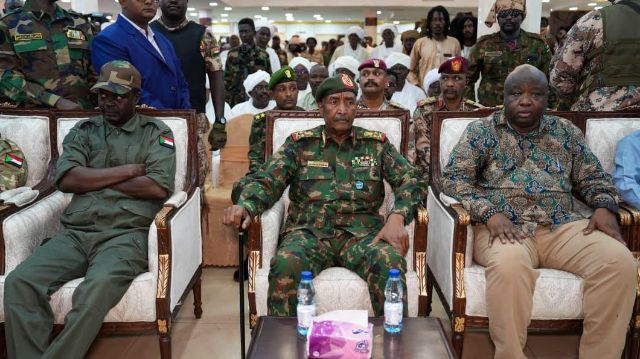
Sudan’s Transitional Sovereignty Council Chairman and Commander-in-Chief of the Sudanese Armed Forces (SAF), General Abdel Fattah al-Burhan, has issued a warning over foreign interference in Sudan’s ongoing conflict, highlighting the regional implications of external support for the paramilitary Rapid Support Forces (RSF).
Speaking in Omdurman on November 28, 2026, Burhan addressed a ceremony honouring wounded members of the Joint Forces, organised through an initiative led by Darfur Regional Governor Minni Arko Minnawi.
The Sudanese leader reaffirmed the military’s determination to safeguard national sovereignty and territorial integrity, while rejecting the continued existence of the RSF as an independent armed formation.
Burhan names four neighbouring countries
Addressing the cross-border dimensions of Sudan’s conflict, Burhan explicitly named Ethiopia, Chad, Libya and South Sudan as countries whose territories were being used by the RSF to launch attacks against Sudan.
He said foreign actors were using their financial resources to recruit fighters and sustain military activities targeting the country.
The Sudanese commander-in-chief warned that foreign combatants currently operating inside Sudan could eventually pose security threats to the countries from which they operate or receive support.
He stressed that the consequences of continued external interference would not necessarily remain confined to Sudan.
His remarks came amid continued diplomatic efforts by the Sudanese government to draw international attention to external military and logistical assistance to the RSF.
Warning against exploiting Sudan’s wartime vulnerability
Burhan rejected the notion that Sudan’s current military and economic difficulties gave foreign actors the freedom to interfere in its internal affairs.
He warned that those responsible for harming Sudan and its population would eventually face consequences.
The commander-in-chief acknowledged that military forces might experience temporary setbacks or reassess their positions during the conflict but maintained that such developments would not undermine the army’s determination.
Burhan expressed confidence that Sudan would recover its strength and called on the international community to help end interference contributing to the country's destruction.
RSF will not be allowed to retain an armed structure
Outlining his position on the future of the Rapid Support Forces, Burhan ruled out allowing the organisation to continue operating as an independent military formation.
He indicated that individual RSF members could surrender their weapons and return to civilian life, while rejecting any arrangement that would allow the group to rebuild its armed capabilities.
The Sudanese leader warned that permitting the re-emergence of the RSF as an armed organisation could create conditions for another conflict in the future.
Burhan also emphasised that the military campaign was not directed against any particular tribe, ethnic community or regional population.
He described the confrontation as a campaign against the RSF and armed elements supporting the organisation.
Military developments in Blue Nile and Darfur
During the ceremony, Burhan referred to ongoing military developments in Ed Damazin, the capital of Blue Nile State, explaining that his involvement in addressing the situation had delayed his arrival in Omdurman.
He highlighted the contribution of the Joint Forces to military operations across several regions and acknowledged their role in supporting the Sudanese Armed Forces.
Addressing personnel fighting in Darfur and Kordofan, Burhan reaffirmed that the military would continue supporting its units operating across those regions.
He expressed hope that future ceremonies and celebrations would take place in towns across Darfur and Kordofan that have suffered extensive damage during the war.
Burhan emphasises unity between the army and Joint Forces
The Sudanese commander-in-chief devoted a significant part of his address to the relationship between the national armed forces and the Joint Forces.
Burhan stressed that members of the Joint Forces should not be regarded as separate from Sudanese army personnel, describing them as participants in the same national military effort.
He acknowledged their contribution to the resilience of the armed forces during different stages of the conflict and paid tribute to personnel who had made considerable personal sacrifices.
Burhan also thanked Darfur Regional Governor Minni Arko Minnawi for his initiative to honour wounded fighters and address their medical and rehabilitation needs.
Although the speech emphasised a shared national military identity, it did not establish a formal timetable or announce a decision concerning the institutional integration of the Joint Forces into the Sudanese Armed Forces.
$5 million pledged for wounded military personnel
Burhan announced a $5 million contribution to a fund established to support wounded members of the Joint Forces.
The funding is intended to address medical treatment, rehabilitation and the economic needs of personnel affected by wartime injuries.
He pledged assistance for soldiers requiring prosthetic limbs and said individuals whose medical conditions could not be treated adequately inside Sudan would receive treatment abroad.
Burhan also announced plans to provide productive assets to wounded personnel whose injuries had affected their ability to earn a living.
He called for beneficiaries to participate directly in the management of the fund and stressed that the financial assistance should not be delayed by administrative procedures.
Military campaign to continue amid economic hardship
Acknowledging the severe economic and social consequences of the war for Sudanese citizens, Burhan maintained that the country needed a lasting resolution to its security crisis.
He argued that allowing the RSF to rebuild its military structure could expose Sudan to renewed instability and armed conflict.
The Sudanese commander-in-chief reaffirmed his commitment to continuing the military campaign and safeguarding Sudan’s sovereignty and territorial integrity.
Direct responses from the governments named in Burhan’s latest address were not included in the coverage reviewed.