Uganda, Norway Sign Joint Declaration to Strengthen Ties
Uganda’s Foreign Affairs Minister Adonia Ayebare and Norwegian Foreign Minister Espen Barth Eide have signed a joint declaration in Oslo aimed at strengthening diplomatic, trade and economic cooperation between the two countries. The agreement, reached on the sidelines of the Nordic–African Foreign Ministers’ Meeting, comes as Uganda seeks greater Norwegian investment and expertise in managing future petroleum revenues.
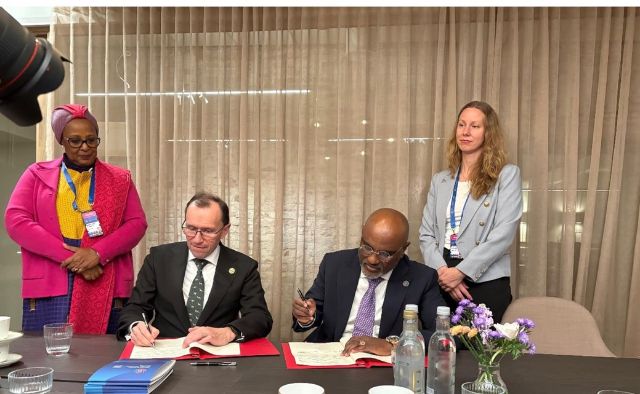
Uganda and Norway have reaffirmed their commitment to expanding bilateral relations following the signing of a joint declaration aimed at strengthening diplomatic engagement, economic cooperation and trade.
Uganda’s Minister of Foreign Affairs, Adonia Ayebare, held bilateral discussions with Norwegian Foreign Minister Espen Barth Eide on the sidelines of the Nordic–African Foreign Ministers’ Meeting in Oslo, held on November 19–20, 2026.
According to a statement published by Uganda’s diplomatic mission in Copenhagen on November 20, the two ministers discussed matters of mutual interest and explored opportunities for deeper cooperation.
The meeting concluded with the signing of a joint declaration reaffirming both governments’ commitment to sustained dialogue and stronger bilateral relations.
Ministers seek stronger trade and investment cooperation
The declaration reflects efforts by Kampala and Oslo to expand economic cooperation and encourage closer engagement between businesses and institutions in both countries.
Ayebare emphasized the importance of exchanging information and experiences in areas relevant to trade, investment and economic development.
Uganda is seeking to attract additional Norwegian investment and improve access to partnerships capable of supporting domestic production and employment.
Previous bilateral consultations held in Kampala in March 2026 highlighted the relatively limited trade relationship between the two countries.
According to Uganda’s Ministry of Foreign Affairs, Ugandan exports to Norway were valued at approximately $1 million in 2024, while imports from Norway totalled around $6 million.
Both governments acknowledged the need to increase trade volumes and develop stronger commercial relationships.
During those consultations, the countries agreed to organize a Uganda–Norway Trade and Investment Summit before the end of 2027 to attract Norwegian businesses and expand economic opportunities.
Uganda looks to Norway’s sovereign wealth fund experience
A significant element of Uganda’s engagement in Oslo involved learning from Norway’s experience in managing revenues generated by petroleum resources.
Minister Ayebare participated in a roundtable discussion titled “Financing the Future” during the Nordic–African gathering.
He also held a separate meeting with Knut Kjær, the first chief executive of Norges Bank Investment Management (NBIM), which manages Norway’s Government Pension Fund Global.
The discussions focused on principles for managing petroleum revenues and building institutions capable of supporting long-term economic stability.
Ayebare identified three lessons Uganda hopes to draw from Norway’s experience: investing petroleum revenues internationally to diversify risks, preserving the fund’s principal while using investment returns to support public expenditure, and establishing strong transparency and accountability mechanisms before oil production begins.
Uganda has established institutions including the Petroleum Fund, the Petroleum Authority of Uganda and the Uganda National Oil Company to oversee different aspects of its petroleum sector.
The government hopes to ensure that future oil revenues contribute to sustainable development rather than being used exclusively for short-term expenditure.
Norwegian investors already active in Uganda
Norway’s development finance institution, Norfund, maintains investments in several important sectors of Uganda’s economy.
According to Uganda’s embassy in Copenhagen, existing investments include the Bujagali Hydropower project, dfcu Bank and Kensta’s sanitary pad manufacturing facility.
In October 2026, Uganda Investment Authority Director General Robert Mukiza met representatives of Norfund in Oslo to explore additional opportunities for long-term investment.
The discussions identified businesses involved in coffee and dairy processing, packaging, cold-chain infrastructure, solar energy and clean cooking technologies as potential investment opportunities.
Ugandan officials proposed submitting between five and ten investment-ready companies for consideration by Norfund.
They also explored opportunities for cooperation between Norwegian development finance institutions, Ugandan pension funds and domestic financial institutions.
These discussions form part of Uganda’s wider strategy to attract international capital, strengthen local manufacturing and increase value addition.
Oslo meeting brings together African and Nordic ministers
The bilateral talks took place during the annual Nordic–African Foreign Ministers’ Meeting, hosted by Norway.
According to the Norwegian Ministry of Foreign Affairs, more than 20 foreign ministers attended the event, with over 30 countries represented.
The discussions focused on international law, geopolitics, stronger trade and investment relationships, artificial intelligence and international cooperation.
An accompanying business forum explored opportunities in energy, critical minerals, digital transformation and climate-related technologies.
The Nordic–African ministerial dialogue was first established in Stockholm in 2001 and has since developed into a regular platform for cooperation between African countries and the Nordic states.
Norway, Sweden, Denmark, Finland and Iceland participate in the framework alongside African partners.
Building on previous diplomatic commitments
Uganda and Norway have maintained diplomatic and development cooperation for several decades.
In July 2024, the two governments signed a memorandum of understanding on political consultations following Norway’s decision to close its embassy in Kampala.
Under the arrangement, Norway’s embassy in Dar es Salaam became responsible for diplomatic relations with Uganda.
The countries subsequently held further consultations in March 2026, covering trade, investment, regional peace and security, refugee protection and cooperation in multilateral institutions.
The latest declaration signed in Oslo builds on those previous engagements and signals continued interest in expanding the bilateral partnership.
However, neither government has publicly announced a specific investment amount or financing package associated with the new declaration.
Further technical discussions and private-sector engagement will be needed to translate the political commitments into concrete projects.