UN and Eight Nations' Envoys Hold Talks in Tigray
A high-level international delegation comprising United Nations representatives, ambassadors from eight countries, including U.S. Ambassador to Ethiopia Ervin Massinga, and international development partners has arrived in Mekelle for a two-day working visit. Discussions with the Tigray Caretaker Administration are focusing on humanitarian needs, the return of displaced civilians, the disarmament and reintegration process, and regional peace and security.
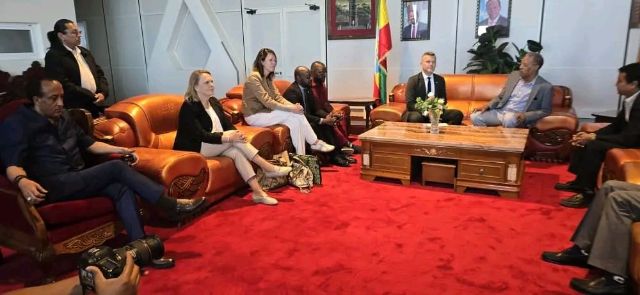
A high-level delegation representing the United Nations, ambassadors from eight countries and international partner organizations arrived in Mekelle, the capital of Ethiopia's northern Tigray region, on November 17, 2026, for a two-day official working visit.
According to Tigray Media Corporation (TMC), the delegation held discussions with senior officials of the Tigray Caretaker Administration on the region's humanitarian, political and security challenges, as well as efforts to restore public institutions and strengthen peace.
The delegation included U.S. Ambassador to Ethiopia Ervin Massinga and Danish Ambassador Sune Krogstrup, alongside other diplomatic and international representatives.
Upon arrival at Alula Aba Nega International Airport, the delegation was welcomed by Assefa Abraha, Chief Executive for Administration and Public Services; Dr. Tedros Aragay, Chief Executive for Economic Affairs and Reconstruction; Redai Hailafom, Chief Executive for Political Affairs and Public Mobilization; and other senior officials of the regional administration.
Ethiopia's Fana Media Corporation also reported that Mekelle Mayor Dr. Shishay Amare was among those receiving the visiting diplomats.
Caretaker administration seeks international support
During the discussions, Assefa Abraha outlined the priorities of the Tigray Caretaker Administration, emphasizing efforts to establish an accountable governance structure that enjoys public acceptance from the regional level down to district administrations.
He said the restoration of basic public services, improvement of security and rehabilitation of war-damaged institutions were central priorities for the administration.
Abraha explained that years of conflict had severely damaged government institutions and essential public service infrastructure, creating substantial challenges for regional governance and economic recovery.
He called on international partners to provide assistance for rebuilding administrative institutions and restoring the services needed by communities across Tigray.
The administration stressed that the recovery of public services, including healthcare, education and local government functions, remains important to the region's transition toward stability.
Danish ambassador outlines objectives of diplomatic visit
Speaking on behalf of the international delegation, Danish Ambassador to Ethiopia Sune Krogstrup expressed appreciation for the reception provided by the Tigray authorities.
He said the two-day visit was intended to provide international representatives with an opportunity to assess conditions directly and identify areas where continued international assistance would be required.
The diplomatic mission is also expected to engage with religious leaders, community elders and civil society organizations to gather perspectives on the humanitarian situation, local governance and prospects for sustainable peace.
The consultations are intended to provide a broader understanding of the challenges facing communities and the priorities that international partners may need to consider in future assistance programmes.
More than 760,000 people remain internally displaced
The humanitarian situation of internally displaced persons (IDPs) remains one of the major issues facing Tigray.
According to figures from the United Nations High Commissioner for Refugees (UNHCR), approximately 761,000 people remained internally displaced in the region as of August 2026.
A United Kingdom government country bulletin published in November 2026 reported that approximately 1.12 million displaced people had returned to their areas of origin, while hundreds of thousands were still unable to return because of insecurity, unresolved territorial disputes and difficulties accessing basic services.
The situation remains particularly challenging for communities displaced from contested areas between Tigray and Amhara, where insecurity, housing and land disputes, and damaged infrastructure continue to complicate returns.
Displaced families and returnees face difficulties accessing adequate shelter, healthcare, education, food assistance and sustainable livelihoods.
Humanitarian assistance and conditions for safe, voluntary and sustainable returns are therefore expected to feature prominently in the delegation's consultations.
Disarmament and reintegration remain central to peace efforts
The ongoing Disarmament, Demobilization and Reintegration (DDR) process is another important issue on the delegation's agenda.
The programme, linked to implementation of the November 2022 Pretoria peace agreement, seeks to support the transition of former combatants from armed organizations into civilian life.
DDR activities generally involve weapons collection, the formal demobilization of fighters and assistance with education, vocational training, economic opportunities and social reintegration.
On October 10, 2026, Ethiopia's National Rehabilitation Commission announced that reception points had been identified across Tigray for combatants willing to leave armed activities and enter the DDR programme.
The commission said the initiative was intended to help former fighters rebuild civilian lives and support long-term stability.
However, renewed hostilities in 2026 have complicated peace implementation efforts, while earlier financial and administrative challenges have also slowed demobilization and reintegration activities.
Successful implementation of the programme remains closely connected to wider security conditions and the restoration of confidence among communities affected by the conflict.
Diplomatic visit follows creation of new caretaker administration
The international delegation's arrival comes approximately one month after Ethiopia's federal government established a new six-month caretaker administration for Tigray.
On October 16, 2026, Prime Minister Abiy Ahmed's government announced the administration following renewed fighting between federal forces and the Tigray People's Liberation Front (TPLF).
The administration was tasked with restoring security, rebuilding damaged infrastructure, re-establishing public services, assisting displaced populations and preparing conditions for free and transparent regional elections.
Its responsibilities also include supporting the disarmament and reintegration of armed elements, strengthening local institutions and facilitating community recovery.
Under the arrangement announced by the federal government, the caretaker administration operates under federal oversight, with its mandate focused on routine governance and election preparations rather than long-term strategic decisions.
The new administration's ability to restore public services and improve security will be important to the region's recovery.
Renewed fighting raises concerns over regional stability
Tigray continues to face serious consequences from the war that began in November 2020 and formally ended with the signing of the Pretoria Cessation of Hostilities Agreement in November 2022.
Renewed fighting between Ethiopian federal forces and TPLF-led armed groups during 2026 has raised concerns about the durability of the peace process and the humanitarian consequences of further instability.
International partners, including the United Nations and Western governments, have called for civilian protection, unhindered humanitarian access, restraint by armed parties and renewed political dialogue based on the principles of the Pretoria agreement.
The visit by ambassadors and international representatives provides an opportunity for direct engagement with regional authorities and community stakeholders on immediate humanitarian priorities and longer-term institutional recovery.
The delegation's two-day programme is expected to contribute to discussions on continued cooperation in humanitarian assistance, reconstruction, peacebuilding and civilian reintegration.
No new financial assistance package or binding agreement has yet been announced as an outcome of the visit.